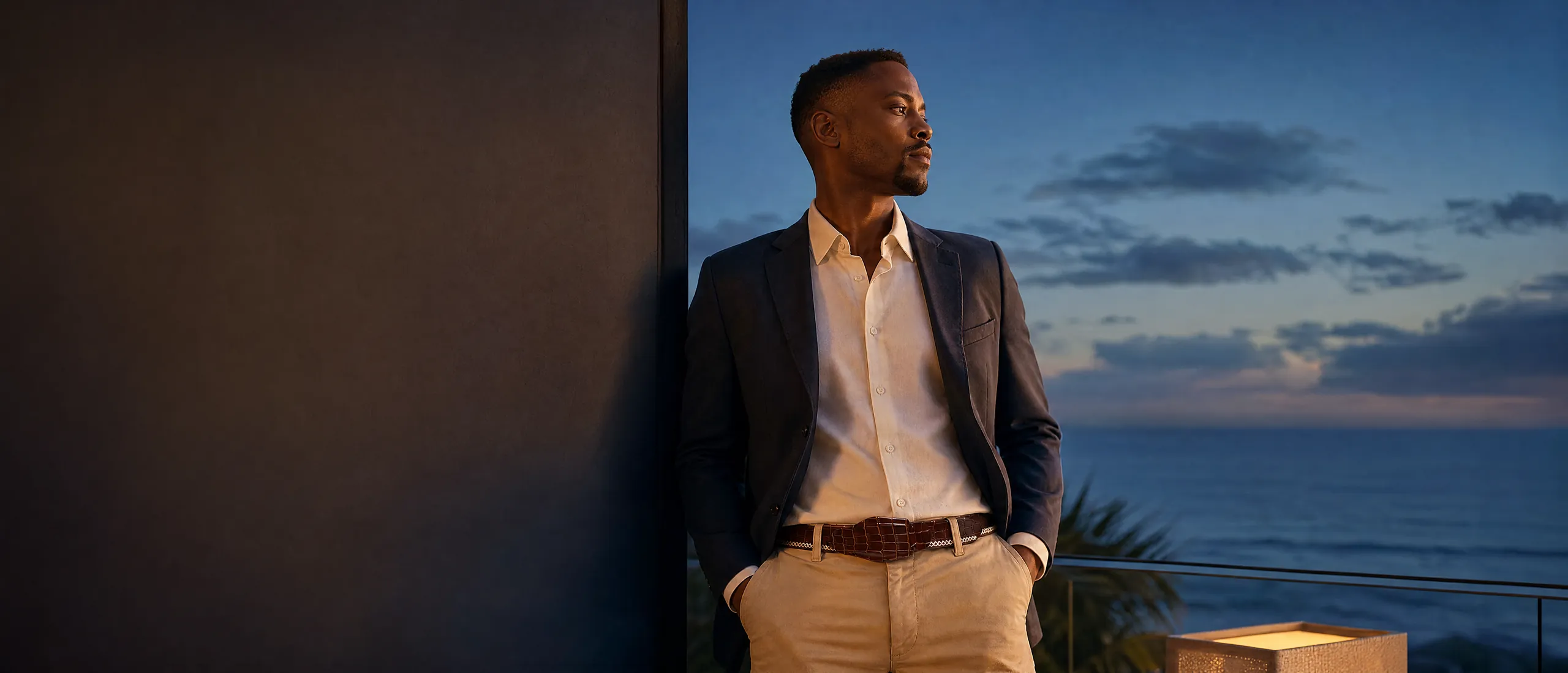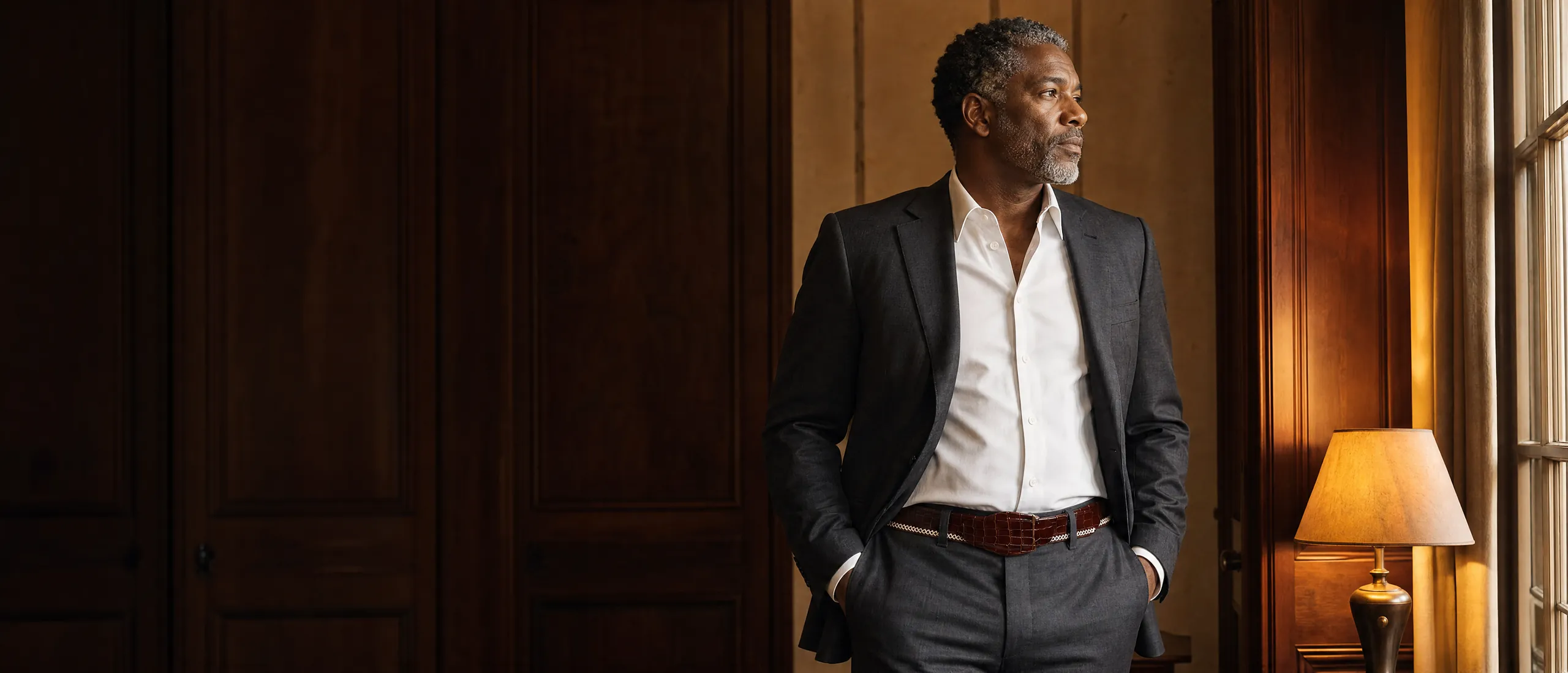
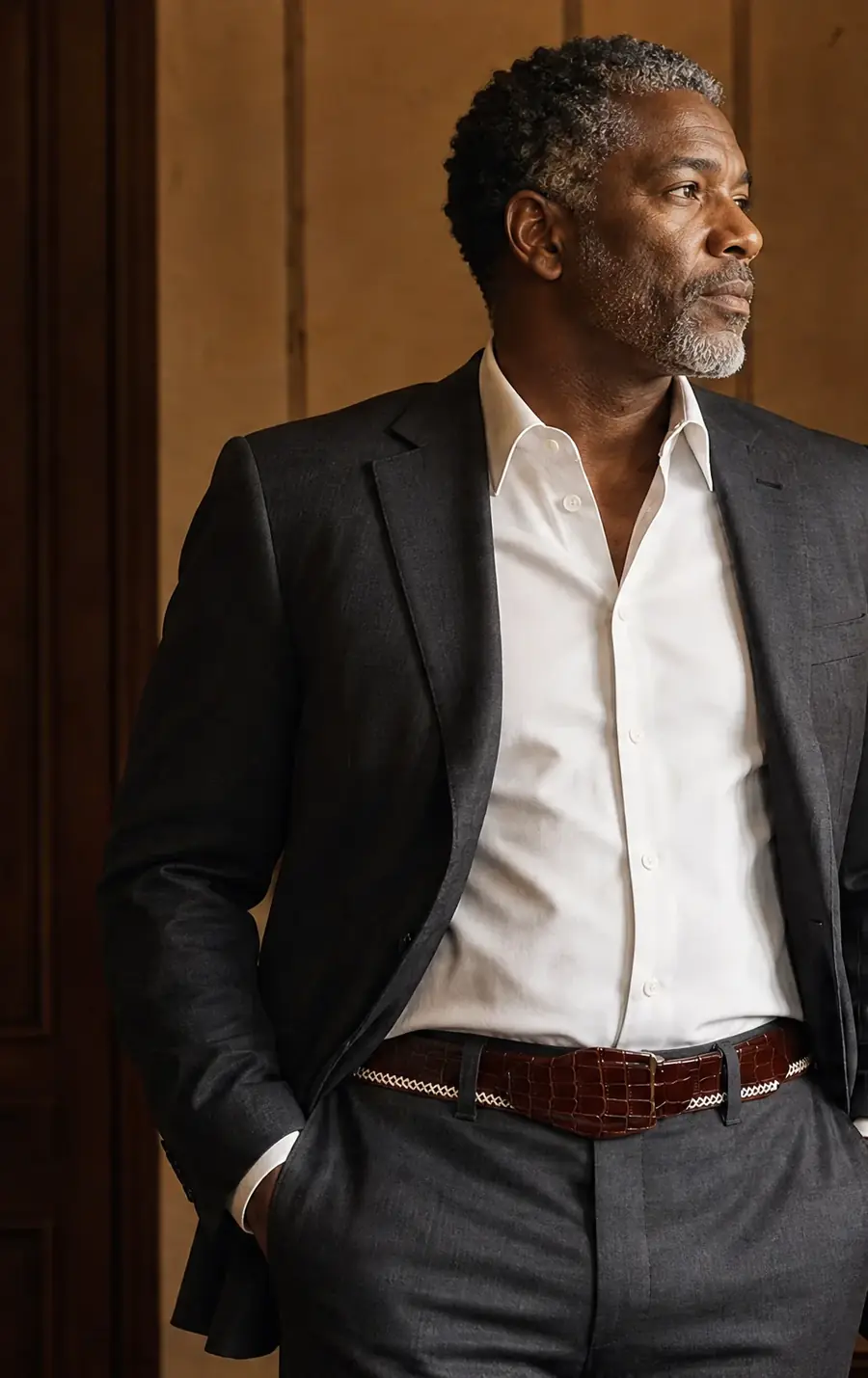
A crocodile belt is one of two things: a belt cut from genuine crocodile skin, or a belt of cattle hide embossed with a crocodile pattern. Both are leather. Only the first is crocodile, and permit rules can apply to it when it crosses a border.
What Is a Crocodile Leather Belt?
A crocodile leather belt is a belt cut from tanned crocodile skin, usually the belly. Many belts sold as crocodile are cattle hide stamped with the pattern, and their descriptions use words such as embossed, print or effect. Crocodile is one of the exotic types of leather.
How Do You Tell Genuine Crocodile From Embossed Leather?
You tell genuine crocodile by the small pore on each scale. Crocodile skin has a sensory pore on every scale, and it remains visible after tanning. Embossed cattle hide has no natural pore.
- Look for the pore: one small dot on each scale.
- Compare the scales. Real scales differ in size and shape, while a stamped pattern repeats along the belt.
- Read the materials line before the name.
Which Crocodile Species Are Used for Leather?
Crocodile leather is the processed hide of one of 23 crocodile species. My advice is to learn four animals before you buy a belt: the Nile crocodile, the saltwater crocodile, the American alligator and the caiman.
| Animal | Where it is raised | What its leather is known for |
|---|---|---|
| Nile crocodile | On ranches all over Africa | Wanted for footwear and belts |
| Saltwater crocodile | Farmed in Australia and other areas | A reputation for the most desirable hide, flexible enough for handbags |
| American alligator | Mostly in Louisiana, Florida and Georgia | An umbilical scar, which no other crocodilian has |
| Caiman | Seldom farmed, though the spectacled caiman is bred in South America | Bony plates in the skin, which make the leather far less pliable |
The four are not valued alike. The Louisiana Department of Wildlife and Fisheries calls alligator and crocodile the classic leathers, and describes caiman as much cheaper at wholesale and more abundant in the market. It also warns that many caiman products are marked crocodile or alligator. Ask for the species by name, and ask for it in writing.
The pattern changes within a species too. A crocodile farming manual published by the FAO records that the Nile crocodile has 26 to 32 rows of scales across the belly, that animals of Madagascar and Mozambique carry the higher count and the smaller scales, and that the leather trade favours a small scale.

What Is the Difference Between an Alligator Belt and a Crocodile Belt?
An alligator belt is cut from the skin of the American alligator, and a crocodile belt from one of the crocodile species. Each leather has its own mark. On crocodile, the pore in each scale remains after tanning. Alligator carries an umbilical scar, an elongated star shape with a webbing pattern in it, and the alligator is the only crocodilian that has one.
The rows differ as well. The alligator has a slightly less even pattern than the crocodile, with some irregular scales, while crocodile rows run more evenly.
A belt is a narrow strip, so the scar may fall outside it, and the Louisiana guide says small products are much harder to identify than large ones. On a belt I would rely on the pore and on a written answer about the species. The words themselves are used loosely: Americans tend to call all crocodile alligator, and Europeans tend to call alligator crocodile.
Crocodile Belly or Hornback: What Is the Difference?
Belly skin comes from the underside of the crocodile and is smooth, with flat, even scales. Hornback comes from the back and carries bony ridges. Belly is the usual choice for a dress belt, because it lies flat under a jacket.
Searches for crocodile belt in South Africa were highest in December 2025, at 170, against 70 to 110 in most other months.
Crocodile Belt, Month by Month
Searches a month, September 2025 to August 2026
- Searches for “crocodile belt”
How Is Crocodile Skin Graded?
Crocodile skin is graded on its size and on the damage it carries. Value is decided by size and by grade. Size means width, and most crocodile skins are priced according to belly width. Grade is a scale of damage, and by the Wikipedia account a skin loses a quarter of its value at each step down.
Farms therefore guard the skin while the animal is alive. Crocodiles are kept in smaller groups to prevent fights, because a scar lowers the grade. Some damage shows only later. A skin that was badly preserved may give no sign until after tanning, when it comes out dull, discoloured or scuffed.
Buttons count against a skin as well. They are small bony deposits inside the belly scales, and the FAO manual names them among the faults that can downgrade a skin. It says belly skins that are free of buttons, and can be given a classic finish by the tanner, are the most valuable, and that the trade regards them as an entirely different material to hornback and to the bony bellies of most caimans.
Grading is done on the skin, long before a belt exists, so I would not expect to find a grade on a label. Ask the seller which grade the strap was cut from, then look along the scales yourself for scars, scratches and dull patches.
Why Is Crocodile Leather Costly?
Crocodile leather is costly because the animals are few and relatively small, and because dependable farms and tanneries are scarce. Those are the reasons given in the Wikipedia article on crocodile skin, which puts all exotic leathers together at less than 1 percent of world leather production.
Cutting adds to the cost. A skin is measured as a whole and not by the width a pattern can use, so it can take several skins to produce a single item. An embossed belt starts from cattle hide, and none of this applies to it. Bought as cattle hide with a pressed pattern, it is an honest choice.
Do You Need a Permit to Take a Crocodile Belt Out of South Africa?
Often, yes. Crocodiles are CITES-listed, and exporting a crocodile leather item from South Africa requires a CITES permit unless it qualifies as a personal effect under the South African CITES Regulations. The country you are entering may set its own rules. Before you travel with one or ship one, ask your provincial conservation authority and the customs service of the country you are entering.
We ship the Safari Crocodile Belly Belt outside South Africa with the required permits.
CITES is the convention on international trade in endangered species. This is general information and not legal advice. Before you buy a genuine crocodile belt from anyone, ask where the skin was farmed and what papers come with it.

Is Crocodile Leather Farmed or Taken From the Wild?
Crocodile leather comes from farmed, ranched and wild animals, and a seller should be able to say which. Ranching, wild harvesting and captive breeding are the three ways of obtaining crocodilians recognised by CITES, and by the Crocodile Specialist Group.
- Farmed. The farm keeps breeding adults and produces its own eggs.
- Ranched. The ranch incubates and rears hatchlings collected from the wild.
- Wild. The animal is taken from a wild population.
CITES lists crocodiles by species and by country. In Species+, the species database developed by UNEP-WCMC and the CITES Secretariat, the Nile crocodile is included in Appendix I, except for the populations of thirteen named countries, South Africa among them, which are included in Appendix II. What each appendix requires of a buyer or a traveller is a question for the authorities named in the permit section above. This is general information and not legal advice.
Before you buy, ask the seller for the species, the country the skin came from, and whether the animal was farmed, ranched or wild.
What Should You Check on a Crocodile Belt Before You Buy?
Check seven things on a crocodile belt before you buy: the creases, the colour, the bend, the joins, the lining, the buckle and the description.
- Creases. On a faux pattern the creases between the tiles are not deep. Run a fingernail along one.
- Colour. Splotchy patterns in the dye point to caiman, whose bony deposits stop dye spreading evenly.
- Bend. Flex the strap gently. Alligator and crocodile are pliable, while creased caiman leather cracks between its plates.
- Joins. Ask whether the strap is one piece of skin or panels joined end to end. Count the joins, and see whether the rows of scales meet across each one.
- Lining. Turn the belt over. I would want a leather lining, named in the description.
- Buckle. See how it is fixed. I prefer a buckle held by a screw, because it can be changed without unpicking the strap.
- Description. It should name the species and the cut, and say embossed wherever the pattern was pressed into cattle hide. Croc alone is not a species.
If you are buying online, ask for a photograph of the belt you will receive, front and back, taken in daylight.
How Do You Wear a Crocodile Belt?
Wear a crocodile belt as the one textured piece in your outfit.
- Match the colour to your shoes.
- Keep the buckle plain. The scales are the decoration.
- Wear it with a suit, or with chinos and an open jacket, so the belt can be seen.
- Leave other exotic leathers out of the same outfit.
Which Width and Colour of Crocodile Belt Should You Choose?
Choose the width by the trousers and the colour by your shoes. Belts for formal trousers are usually 28 to 32 mm wide, and casual belts worn with denim are usually between 35 and 42 mm.
| Worn with | Width | What I would choose |
|---|---|---|
| A suit | 28 to 32 mm | Black or dark brown belly, matched to the shoes |
| Chinos and a jacket | About 32 to 35 mm | Brown or tan belly |
| Denim | 35 to 42 mm | Brown, tan or a colour, in belly or hornback |
The middle width is my own judgement. Measure your belt loops before you order, because a strap wider than the loop will not pass through it.
Crocodile takes colour well. The Louisiana guide says the smooth, homogenous skin of alligator and crocodile allows dyes to distribute evenly. For a first crocodile belt I would still choose black or brown, since either can be worn on most days. A bright colour makes a better second belt.

How Do You Care for a Crocodile Belt?
Keep a crocodile belt away from prolonged direct sun and from moisture. We advise wiping it with a soft, dry cloth, and hanging it by the buckle or coiling it loosely between wears. Smooth leather is covered in our leather care guide.
What Damages a Crocodile Belt?
Sharp folds, heat, water and household cleaners are the four things we advise keeping away from a crocodile belt.
- Folds. Do not fold the belt or roll it tightly. Certain glazes make the leather stiffer and prone to cracking.
- Heat. Keep it off a sunny windowsill and out of a parked car. If the belt gets wet, let it dry at room temperature, never with a hairdryer or a heater.
- Water. Blot rain with a soft, dry cloth. Do not rub across the scales.
- Cleaners. Use no alcohol, hand sanitiser, wipes or household cleaner. If you condition the belt, choose a product made for reptile leather and test it on the inside of the tip first.
At night, take the belt out of your trousers, and give it a day of rest between wears.
Which of Our Belts Is Genuine Crocodile?
The Safari Crocodile Belly Belt is genuine crocodile belly leather. The Sahara Crocodile-Embossed Leather Belt is full-grain cowhide with a deep crocodile-embossed pattern.
| Leather belt | Leather | Price |
|---|---|---|
| Safari Crocodile Belly Belt | Genuine crocodile belly, large tile pattern | R3,900 |
| Sahara Crocodile-Embossed Leather Belt | Full-grain cowhide, crocodile-embossed | R3,500 |
Our crocodile hide comes from South Africa, from certified farms, and each hide is traceable across the supply chain. Our page on how we source leather says more. Both belts are made to order to your chosen size. If the size is wrong, a belt can be exchanged under our return policy.
See all our leather belts, or read about ostrich leather.
More on Hides and Leathers
Questions, Answered
How do you tell if a crocodile belt is real?
Look for a small pore on each scale, and for scales that differ in size and shape. Embossed cattle hide has no natural pore and its pattern repeats.
Do you need a permit for a crocodile belt?
Often, when it leaves the country. Crocodiles are CITES-listed. Exporting a crocodile leather item from South Africa requires a CITES permit unless it qualifies as a personal effect, and the country you enter may set its own rules. This is not legal advice.
How do you wear a crocodile belt?
As the one textured piece in the outfit: matched to your shoes, with a plain buckle, under an open jacket or with a suit.
Where can I buy genuine crocodile leather?
From a maker who states the leather in the materials line and can say where the skin was farmed. Our Safari Crocodile Belly Belt is genuine crocodile belly, sourced in South Africa.
Is a crocodile-embossed belt real leather?
Yes. It is real cattle hide with a crocodile pattern pressed in. It is not crocodile skin.
What is the difference between alligator and crocodile belts?
An alligator belt is cut from American alligator skin and a crocodile belt from a crocodile species. Crocodile leather keeps a small pore on each scale. Alligator leather has an umbilical scar, which no other crocodilian has, though on a narrow belt the scar may not appear.
Is crocodile leather costly?
Yes. The animals are few and relatively small, dependable farms and tanneries are scarce, each skin is priced by width and grade, and one item can take several skins.
How much is a real crocodile belt?
It depends on the species, the cut and the grade of the skin. Our Safari Crocodile Belly Belt, in genuine crocodile belly, is R3,900. Our crocodile-embossed belt in cattle hide is R3,500.
Read all our questions and answers