








To clean a leather bag, wipe it with a soft dry cloth, lift marks with a barely damp cloth, and let it dry in the air. That method suits most leather at home and does it no harm. The rest of the page covers what never to use, how often to condition the leather, how to store a bag in a humid city, and the care each part of a leather backpack needs.
How Do You Clean a Leather Bag at Home?
You clean a leather bag at home in four steps, and none of them needs a household cleaner.
- Empty the bag and shake out the lining.
- Wipe the leather with a soft, dry cloth to lift dust.
- For a mark, use a cloth that is barely damp with clean water. Wipe gently and do not scrub.
- Let the bag dry in the air at room temperature, away from sun and heaters.
Test anything new on a hidden part of the bag first, such as the base.
What Do You Need to Clean a Leather Bag?
You need two or three soft white cloths, clean water, a soft brush, a colourless conditioner made for smooth leather, and a cloth dust bag. Find each in the first column.
| Item | Use | Note |
|---|---|---|
| Soft white cloths | Dry wipe, damp wipe, buffing | No dye can come off onto damp leather |
| Clean water | The only liquid we advise | Nothing in it to leave a residue |
| Soft brush | Dust from seams, zips and suede panels | Keep it for leather only |
| Vacuum brush nozzle | Crumbs and dust in the lining | Use a low setting |
| Colourless conditioner | Two or three light coats a year | A tinted product can mark clothes |
| Plain tissue | Fills the bag to hold its shape | Newsprint can mark leather |
| Cloth dust bag | Storage between uses | Plastic traps moisture |
That is the whole kit. I would not buy a single bottle that claims to clean, condition and protect at once; those are three jobs, as our section on conditioner explains.
Can You Use Vinegar, Baking Soda or Baby Wipes on Leather?
No. We advise against vinegar, baking soda and baby wipes on a leather bag. Advice on vinegar is divided, and we would not risk it on full-grain leather.
Mild soap and saddle soap are often suggested for leather. We would keep saddle soap for boots and saddles, and use no soap on a full-grain leather bag.
Keep these away from leather as well.
- Household cleaners that contain bleach or ammonia.
- Alcohol, hand sanitiser and nail varnish remover.
- A hairdryer, a heater or a sunny windowsill for drying.
- A washing machine.
What Is Leather Conditioner, and How Often Should You Use It?
Leather conditioner is a cream or wax that puts oils back into leather so it stays supple. We advise a light coat two or three times a year.
- Clean the bag first and let it dry.
- Put a small amount of conditioner on a soft cloth, not on the leather.
- Work it in with small circles, then leave it for an hour.
- Buff with a clean, dry cloth.
Choose a conditioner made for smooth leather, with no colour in it. Too much conditioner darkens leather and leaves it sticky, so use less than you think you need.
What Is Leather Conditioner Made Of, and How Do You Choose One?
A leather conditioner is made of oils, fats and waxes, and you choose one by reading its ingredients against the leather you own.
The case for using one is that new leather contains natural oils that keep it soft and supple, and those oils evaporate over time. The leather then shrinks and stiffens, and it sometimes cracks. Four traditional products show what goes into a tin.
- Dubbin. A greasy or waxy product of waxes and oils. Commercial dubbin contains petroleum jelly, paraffin wax and neatsfoot oil. Older recipes use beeswax, fish oil and lard. It softens leather and waterproofs it.
- Neatsfoot oil. A yellow oil rendered from the shin bones and feet of cattle. A product sold as neatsfoot oil compound is a blend with mineral or other petroleum-based oils.
- Lanolin. The grease of sheep’s wool. Mixed with neatsfoot oil, beeswax and glycerol, it is used in leather treatments, some saddle soaps among them.
- Saddle soap. A compound that typically contains mild soap, softening ingredients such as lanolin and preservatives such as beeswax. We advise against it on a full-grain leather bag, for the reason given higher up this page.
For a bag, my advice runs in this order.
- Match the product to the surface. A cream or lotion suits smooth leather. Nothing oily belongs on suede, nubuck or hair-on-hide.
- Buy one that lists its ingredients, and choose a colourless one. A bag rubs against clothes, and a tinted product can come off on them.
- Prefer a thin cream to a heavy grease. Dubbin and its kind are made to waterproof boots, and on a bag I would expect them to darken the leather and leave it tacky.
- Be wary of a single product that claims to clean, condition and waterproof. Those are three jobs.
- Test it on the base, and look at the patch the next day in daylight before you go further.
Shoe polish is a separate product, and it stays with the shoes. Leather shoes are widely conditioned with shoe polish, which is made to give shine and colour. A bag rests against a shirt or a car seat, and I would not want wax and colour coming off there.
Museums take a more cautious view than ours, and you should know it. The Canadian Conservation Institute, which writes for the keepers of museum collections, says that applying dressings and saddle soap is now not generally recommended as a treatment for leather. Its reasons: oil added where none is needed can stiffen leather, many oils oxidise with time, and saddle soap is very alkaline. The Institute also points out that a museum object no longer has to be flexible. A bag does, because it is bent every day it is carried, so we keep to a light coat two or three times a year. I take the museum’s findings as a good reason to use less than you think you need.

Can You Use Olive Oil or Coconut Oil on Leather?
No. Do not use olive oil, coconut oil or other cooking oils on a leather bag. They can darken the leather unevenly and leave it greasy. Use a conditioner made for leather.
How Often Should You Clean a Leather Bag?
Wipe a leather bag in daily use once a week, clean it properly once a month and condition it two or three times a year. The table is the routine we advise for a bag carried on most days. A bag carried a few times a month needs only the monthly steps, done before it goes back into its dust bag.
| When | What to do | Why |
|---|---|---|
| Each week | Empty the bag, shake out the lining and wipe the outside with a soft, dry cloth | Dust and grit come away before they are pressed into the grain |
| Each month | Wipe the handles, straps and corners with a barely damp cloth, brush the zips, and look over the seams and fittings | The parts your hands touch take the most soil, and a loose stitch found now is a small repair |
| Two or three times a year | Condition lightly, then check the base, the edges and the lining | This is the light coat described higher up this page |
| Once a year | Empty every pocket, air the bag in the shade for a day and decide whether anything needs a repairer | It is the one time the whole bag is looked at together, inside and out |
Adjust the routine to the climate and the colour. In a humid coastal city I would air the bag more often than the table says. A pale leather shows soil sooner, so give it the monthly wipe every two weeks.
Cleaning more often than this does the leather no good. The natural oils in leather can be washed out by repeated exposure to water, which is why the weekly step is a dry one.
How Do You Care for Each Part of a Leather Backpack?
A backpack wears in different places from a handbag, so each part needs its own attention.
| Part | What happens to it | What we advise |
|---|---|---|
| Straps | They take oil and sweat from your hands and shoulders | Wipe them with a dry cloth each week |
| Back panel | It rests against your clothes and takes on moisture | Air the bag overnight after a long day |
| Base | It sits on floors and pavements | Set the bag down on clean, dry surfaces and wipe the base often |
| Zips and fittings | Dust collects along the teeth | Brush them with a soft, dry brush |
| Lining | Crumbs and pen marks gather inside | Shake it out and wipe it with a damp cloth |
How to clean a leather bag drew between 110 and 210 searches a month in South Africa, highest in December 2025 and January 2026.
Searches for How to Clean a Leather Bag
Searches a month, September 2025 to August 2026
- Searches for “how to clean leather bag”
How Do You Clean Each Kind of Leather Bag?
Each kind of leather bag gets dirty in its own places, so clean where it is handled and where it rests: the handles of a handbag, the straps and back of a backpack, the base and corners of a briefcase. Find the bag in the first column. The advice is ours.
| Bag | Soils at | Our advice |
|---|---|---|
| Handbag | Handles, the top edge, the base | Damp wipe the handles monthly; clean hands help most |
| Backpack | Straps, back panel, base | Dry wipe the straps weekly; air the back overnight |
| Briefcase | Handle, corners, base | Wipe the corners; never set it on a wet floor |
| Tote | Handles, open top, lining | Vacuum the lining often; it collects grit |
| Crossbody bag | The strap and the side worn against you | Wipe the strap; watch for denim dye |
| Clutch or evening bag | Fingerprints, make-up marks | Dry cloth after each use; store apart |
| Laptop bag | Handle, base, laptop sleeve | Brush the sleeve; keep liquids in a closed pocket |
A bag made of several leathers, such as smooth panels with suede or hair-on-hide, is cleaned panel by panel, beginning with the most delicate. The section on suede, patent and exotic leathers sets out what changes for suede, patent, hair-on-hide, ostrich and crocodile.
How Do You Clean Suede, Nubuck, Patent and Exotic Leather Bags?
You clean each of these by its surface: brush a napped leather, wipe a coated one, and keep an exotic skin or a hair-on hide as dry as you can. The steps at the top of this page are written for smooth leather. Our guide to the types of leather carries the full care table for every finish, so the table here keeps to what changes when the leather is on a bag.
| Leather on the bag | What changes on a bag |
|---|---|
| Suede or nubuck panels | Brush them dry, in one direction, before you wipe the smooth panels beside them. Keep the damp cloth and the conditioner off the nap |
| Patent | Give it a dust bag of its own, so that it never rests against a darker bag in the cupboard |
| Hair-on-hide | Wipe the way the hair lies, and use no conditioner. Our page on Nguni hide has the detail |
| Ostrich and crocodile | Use a soft, dry cloth, worked around the quill marks or along the scales, and blot a spill at once. See ostrich leather and crocodile leather belts |
A bag is often made of more than one leather, which a pair of gloves or a belt seldom is. Clean each panel by its own rule, and begin with the most delicate one, so that nothing meant for smooth leather strays onto suede or hair.
If you do not know what the leather is, treat it as the most delicate it could be. Use a dry cloth only until you have asked the maker.
How Do You Clean a Faux Leather Bag?
Clean a faux leather bag by its label: wipe it with a dry cloth, and if the maker allows it, with a cloth barely damp with mildly soapy water, then dry it at room temperature.
Check the label first. If it says polyurethane, PU, PVC or vegan leather, the bag is a coated fabric, not leather, and the maker’s care text is the rule. A coated fabric does not absorb water as leather does, so in my view the soapy cloth that we keep off full-grain leather is usually safe on it. Leave conditioner off: a coating has no oils to replace. Keep it away from heat and direct sun, which can make a coating crack or peel. If you cannot tell which it is, treat it as leather and use a dry cloth until you know. Our guide to the types of leather explains how to tell faux leather from real.
How Do You Clean a Second-Hand or Vintage Leather Bag?
Clean a second-hand or vintage leather bag slowly: inspect it, air it, clean it dry, deal with the lining, and condition it lightly only once it is clean and dry.
- Inspect it in daylight. Look for cracks, flaking, loose stitching, a white film and a musty smell. Each tells you what the bag needs.
- Air it. Empty it, open every pocket and leave it in the shade, with air moving through it, for a day or two.
- Clean it dry. A soft brush and a dry cloth, outdoors if there is any sign of mould. Wear a mask and gloves for mould.
- Wipe it once with a barely damp cloth, panel by panel, and let it dry fully.
- Clean the lining with a vacuum brush. A lining that smells after two weeks of airing may need replacing.
- Condition lightly. Old leather is often dry, and the temptation is to use a lot. Use less than you think, test it on the base, and add a second light coat a week later if needed.
Cracked or flaking leather will not be restored by conditioner. I would take a vintage bag with cracks, or one of real value, to a repairer before you try anything wet.
How Do You Clean the Lining, Zips and Metal Fittings of a Leather Bag?
Clean the lining with a vacuum and a damp cloth, the zips with a dry brush and the metal with a dry cloth, and keep every liquid off the leather beside them.
- A fabric lining. Pull the lining out if it is loose, shake it over a bin, then vacuum the seams with a brush nozzle on a low setting. Dab a mark with a cloth dampened in clean water, and with nothing else. Leave the bag open until the lining is dry right through, because a damp lining shut inside a bag is where I would expect mould to start.
- A leather or suede lining. A dry cloth or a soft brush, and nothing wet.
- Pen marks inside. Leave them. Rubbing spreads the ink, and a wet cloth can carry it through to the leather.
- Zips. Brush the teeth with a soft, dry brush. If a zip drags, look for a thread or a fold of lining caught in the teeth before you pull harder. I would not put oil or a spray lubricant on a zip, since either can creep into the tape and the leather alongside. A zip that still sticks is a small job for a repairer.
- Buckles, rings and studs. Rub them with a soft, dry cloth to take off fingerprints. Leave metal polish out. It can mark the leather around the fitting, and I do not trust it on plating.
A waxy green deposit where a brass fitting meets the leather has a known cause. The Canadian Conservation Institute explains that copper and its alloys, brass and bronze, react with the oils in leather and form waxy green corrosion products where the two touch. In a museum the deposit is removed with a wooden stick and then a swab dipped in solvent. On a bag I would stop at the wooden stick, or a dry cotton bud, and work away from the leather. Then keep that part of the bag dry, and go easy with conditioner around the metal.
How Do You Remove a Stain From a Leather Bag?
Blot a fresh stain at once with a dry cloth, and do not rub it. Water marks often fade when the whole panel is wiped evenly with a barely damp cloth and left to dry.
For ink, grease and old stains we advise a repairer before you try anything. Our leather bag repair page explains what can be restored.

How Do You Treat Ink, Grease, Dye and Other Stains on a Leather Bag?
Treat every stain on a leather bag the same way at first: blot it, do not rub it, and use nothing harsher than clean water. What follows depends on the stain, and for several of them the right move at home is to stop.
| Stain | What to try at home | When to go to a repairer |
|---|---|---|
| Ink | Blot a wet mark once with a dry cloth. Nothing more | At once. We would not use alcohol, hairspray or nail varnish remover, any of which may take the finish off with the ink |
| Grease and oil | Blot with a dry cloth and add no water, which will not mix with the oil. Then leave the mark alone | Before you try anything else |
| Water marks | Wipe the whole panel evenly with a barely damp cloth and let it dry in the air | If a ring is still there after two attempts |
| Food and drink | Lift solids with the edge of a spoon, blot, then wipe once with a barely damp cloth | If colour is left behind. Red wine, coffee and curry are the ones I would watch |
| Make-up | Press a dry cloth onto lipstick or foundation and lift. Do not wipe, and use no make-up remover | If a greasy shadow or a tint remains |
| Denim dye | A dry cloth first, then a barely damp cloth, once | If the blue does not lift. Recolouring a panel is repair work |
| Salt from sweat or sea air | Wipe the whole panel with a barely damp cloth, let it dry, then condition | If the leather has stiffened or paled along a line |
Three habits make any of these attempts safer.
- Use a white cloth, so that no dye comes off the cloth and you can see what is lifting.
- Work inwards, towards the middle of the mark, so that it does not spread.
- Make one attempt, then let the leather dry fully before you judge it.
When you do go to a repairer, say what the stain is, how old it is and what you have already tried. Our page on leather bag repair sets out which stains can be reduced and which cannot.
Dye transfer is easier to prevent than to treat. I would not carry a pale bag against new dark denim, or leave it resting on a printed magazine.
How Do You Remove Mould From a Leather Bag?
Wipe the mould off with a dry cloth outdoors, let the bag air in the shade, then condition it. Mould comes from damp storage, so change where the bag is kept.
Is the White Film on a Leather Bag Mould, Salt or Wax?
A white film on a leather bag is one of three things, mould, salt or a bloom of fat or wax, and each looks different under a good light.
The Canadian Conservation Institute describes mould as a thin grey, green or white powdery deposit, or small black dots, on the surface of the leather. It adds that fatty blooms left by dressings, soap left by cleaners and salts left by perspiration can all resemble mould. The first two are slightly waxy, it says, and the salt is crystalline.
- Mould. Powdery and in patches. A musty smell from the bag points the same way. Follow the steps in the section above.
- Salt. Gritty. Look for it in a line where sweat or sea spray has dried. Wipe the whole panel with a barely damp cloth, let it dry and condition it.
- Bloom. A dull, waxy haze that follows conditioning. Buff it away with a dry cloth and use less product next time.
Mould cannot wait. In its note on removing mould from leather, the Institute says that humidity between 65 and 100 percent, warmth and poor air circulation promote it, and that mould generally grows after two days at 90 to 100 percent relative humidity, 10 days at 80 percent and 100 days at 70 percent. I would never put a rain-soaked bag into a cupboard on the same night.
That note is written for museums, and its method is stricter than ours. It calls for a respirator, disposable gloves and goggles, and for removing the mould with a filtered vacuum cleaner, and it warns that some spores are likely to remain even after careful cleaning. For one bag in daily use we keep to the dry cloth, outdoors, that the section above describes. Add a mask and gloves, pick a dry day, and wash or throw away the cloth afterwards. If you are allergic or asthmatic, hand the job to someone else, which is the Institute’s advice as well.
How Do You Get a Smell out of a Leather Bag?
Air is the remedy for a smell in a leather bag: empty it, open every pocket and leave it in the shade, with air moving through it, for a day or two.
Find the source before you do anything else. Put your nose to the lining, then to the leather. Spilt food, perfume and damp collect inside, so I would expect the lining to be the source more often than the leather, and a lining can be cleaned as the section on linings describes.
- A musty smell. This is damp, and it may be mould you cannot yet see. Dry the bag fully, check the seams and the base inside, and change where the bag is kept.
- Smoke or food. Air the bag for several days running. Fill it loosely with plain, unprinted paper and change the paper each day.
- The smell of new leather. It needs no treatment. In my view it fades with use.
We would not spray perfume or fabric freshener into a leather bag. Both add liquid and scent on top of the smell, and neither removes its cause. Keep the bag out of the sun while it airs.
A smell that is still there after two weeks of airing has, in my view, settled into the lining or its padding. A repairer can replace a lining, and that is when I would ask.
How Should You Store a Leather Bag?
Store a leather bag in its dust bag, stuffed lightly so it keeps its shape, in a cool and dry cupboard.
- Use a cloth dust bag. Never store leather in plastic, which traps moisture.
- Keep it away from direct sun, radiators and heaters. The Canadian Conservation Institute advises 18 to 20 degrees and 45 to 55 percent humidity for leather, and notes that mould needs humidity above 65 percent.
- Rest a bag between uses so the leather recovers its shape.
In Durban and along the coast the air is humid for much of the year. There I would add a sachet of silica gel to the cupboard and air the bag every few weeks.
How Do You Store a Leather Bag for a Whole Season?
To store a leather bag for a season, clean it, let it dry, fill it, cover it in cloth and keep it in the dark where air can move around it.
- Empty every pocket. A forgotten pen, lipstick or sweet can leak or melt into the lining over a summer.
- Clean and condition the bag about a week before it goes away, so that the conditioner has settled and the leather is dry.
- Fill it with plain tissue until it holds its shape without bulging. Leave newspaper out. The museum advice below keeps leather away from newsprint.
- Undo the buckles. Lay a detachable strap inside the bag, wrapped in tissue, so that its buckle does not press a mark into the leather.
- Wrap chains and large metal fittings in tissue as well.
- Put the bag in its dust bag and stand it upright on a shelf. Do not hang it by its handles, and do not stack anything on top of it.
- Take it out every few weeks, look it over and let it air for an afternoon.
Museum practice gives reasons for several of these steps. The Canadian Conservation Institute advises that leather should, where possible, be stored in the dark, with folds and rounded shapes padded with acid-free tissue. It advises preventing direct contact between leather and metal parts wherever that can be done, and keeping leather away from ink and newsprint. Dyed leather, it notes, can be extremely sensitive to light.
Dry air does harm of its own. The Institute puts the danger line at 30 percent relative humidity, below which leather loses moisture and turns brittle, and it warns against storing leather over radiators. So a shelf above a heater is the wrong place, and I would say the same of a box in the roof space, however safe from mould it may seem.

How Does South African Weather Affect a Leather Bag?
South African weather affects a leather bag mostly through humidity on the coast, dry air on the Highveld in winter, summer storms inland and the heat of a parked car.
The difference between cities is large. In September, Durban averages 77 percent relative humidity, against 47 percent in Johannesburg. As the section on mould notes, from museum advice, mould needs humidity above 65 percent, so a bag kept in a Durban cupboard faces a risk that one in a Johannesburg cupboard in the same month does not.
| Place | What happens | Advice |
|---|---|---|
| Durban, the coast | Humid air most of the year | Air the bag every few weeks; silica gel in the cupboard |
| Highveld, winter | Dry air, heaters indoors | Condition on schedule; keep it off a shelf above a heater |
| Highveld, summer | Afternoon storms | Blot rain at once; dry it slowly at room temperature |
| Cape Town, winter | Rain and wind | Wipe it dry when you get in; never store it damp |
| Any car in summer | Heat on the seat and in the boot | Never leave a leather bag in a parked car |
If your bag gets caught in rain, blot it with a dry cloth, stuff it with plain paper and let it dry at room temperature. The section on a wet bag has the full steps.
What Should You Do If a Leather Bag Gets Wet?
Blot the water with a dry cloth, stuff the bag with paper and let it dry at room temperature. Our article on what to do when a leather backpack gets wet gives each step, and covers wax and protector spray.
Which Mistakes Should You Avoid When Caring for a Leather Bag?
The mistakes to avoid are the ones that put something into the leather that cannot be taken out again: too much water, too much product, heat and colour. The list of household products higher up this page covers what not to use. These are mistakes of method.
- Scrubbing. Pressure can roughen the grain and push soil in. Wipe, lift and repeat.
- Cleaning only the spot. A wet patch can dry with an edge. Wipe the whole panel, seam to seam.
- Using a coloured cloth. The dye in a cloth can move onto damp leather.
- Conditioning a dirty bag. Conditioner over dust rubs the dust in. Clean first, as the steps say.
- Skipping the test patch. A product that suits one leather can darken the next.
- Storing a full bag on a hook. The weight pulls on the handles and their stitching for months.
- Carrying it with freshly creamed hands. Hand cream and sanitiser pass straight to the handles.
- Trying a third remedy. If two gentle attempts have failed, I would not expect a harsher one to succeed, and it leaves the repairer less to work with.
How Do You Keep a White or Pale Leather Bag Clean?
Keep a white or pale leather bag clean by wiping it more often, keeping it away from dark dyes and storing it in the dark.
- Wipe it with a dry white cloth after each day of use, and give it the barely damp wipe every two weeks.
- Keep it off dark denim, printed paper and the dark lining of a coat.
- Store it in a pale cloth dust bag, apart from dark bags.
- Handle it with clean, dry hands. Cream, sunscreen and make-up show on pale leather sooner than on dark.
- Use a colourless conditioner, and test it first, in case it tints the leather.
For yellowing I have no home remedy to offer. We would not put bleach, peroxide or toothpaste on leather, whatever a guide promises, and I know of nothing else I would trust on a good bag. Light is the part you can control. The Canadian Conservation Institute warns that damage from light is cumulative and irreversible, and that direct sunlight and daylight can discolour leather. A pale bag left on display near a window is therefore at more risk than one kept in a cupboard.
If a pale bag has yellowed or greyed evenly, ask a repairer about cleaning and recolouring the whole bag. Treating one panel leaves it brighter than its neighbours.
When Should a Leather Bag Go to a Professional?
Take a leather bag to a professional for ink, grease, dye, a stain that two gentle attempts have not moved, cracked or flaking leather, loose stitching, a broken zip or strap, and anything of real value.
- Tell them what the stain is, how old it is and what you have already tried.
- Ask what they will use, and whether they will test it on a hidden part first.
- Ask whether the colour will change, and whether they would treat one panel or the whole bag.
- A good repairer tells you plainly when a mark will not come out.
We repair only the pieces we make, and we do not repair other makes. For one of our backpacks, our repair page explains how to send a photograph for a quote.
How Do We Advise Caring for Our Pieces?
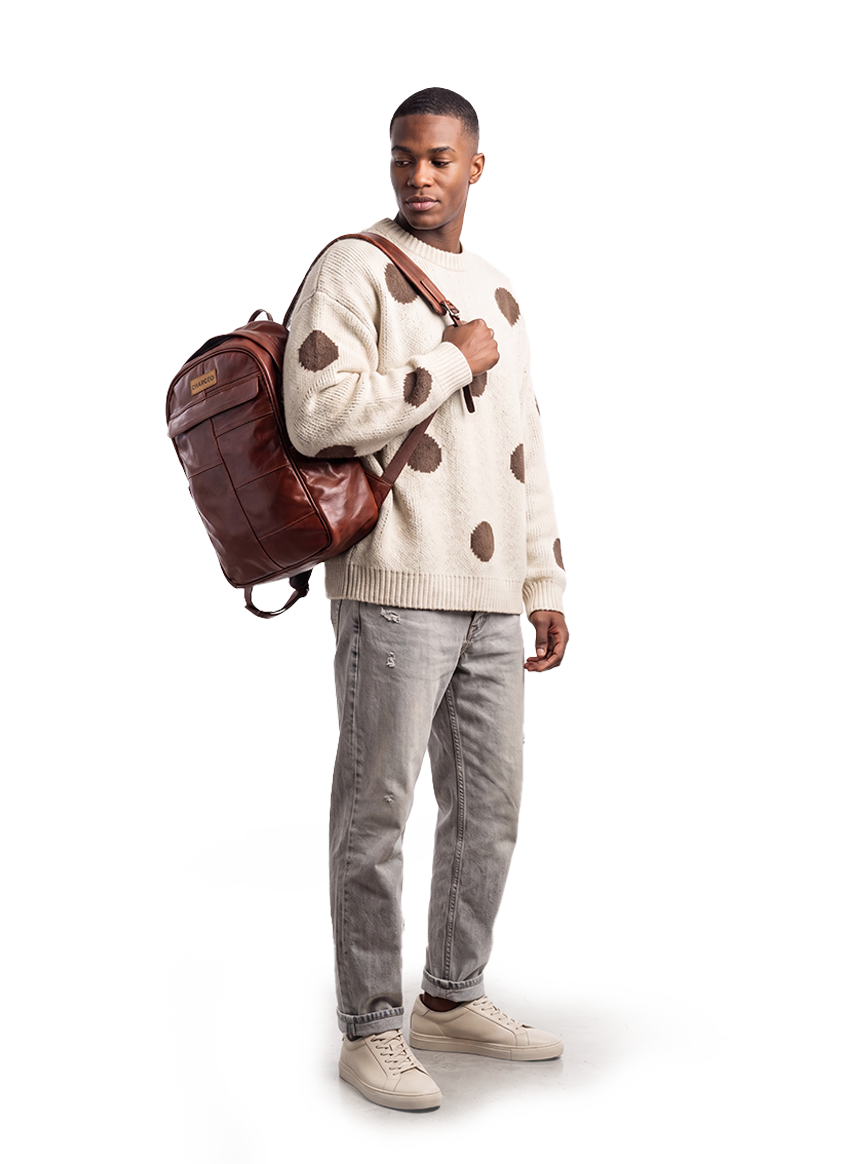
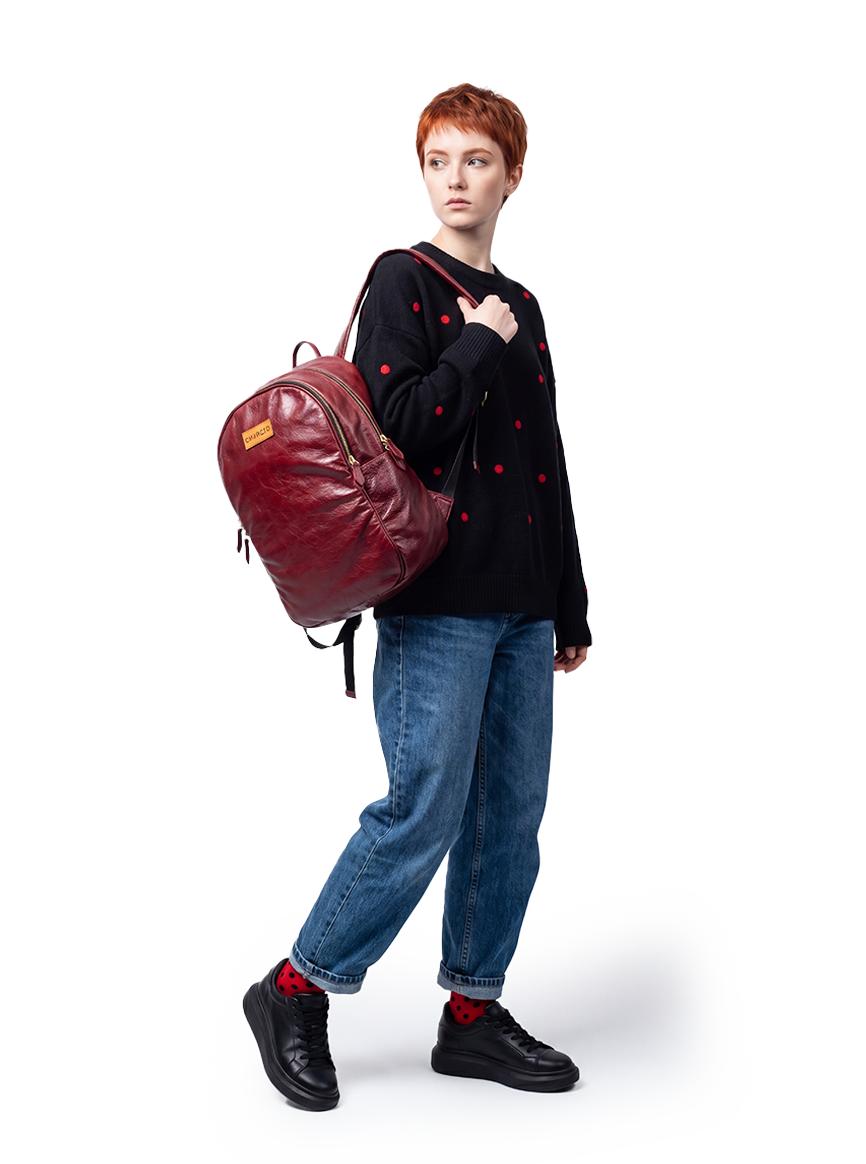
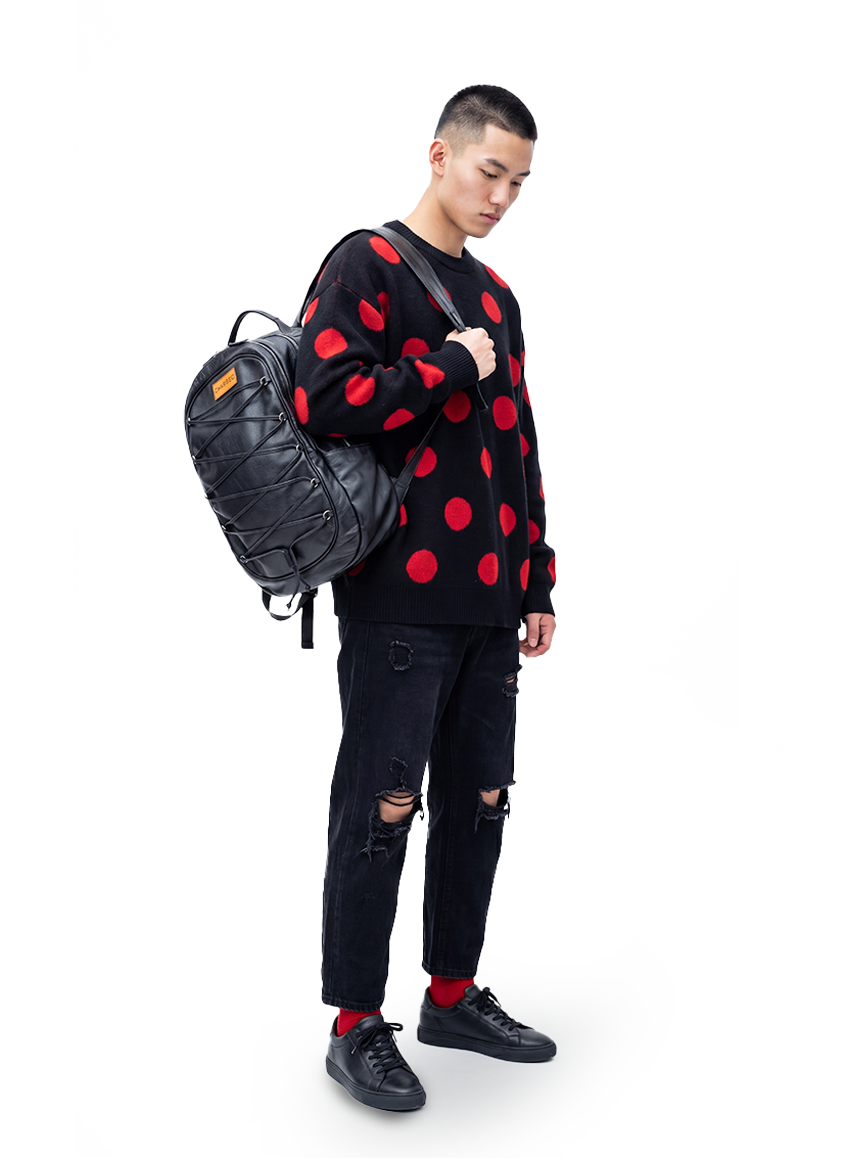
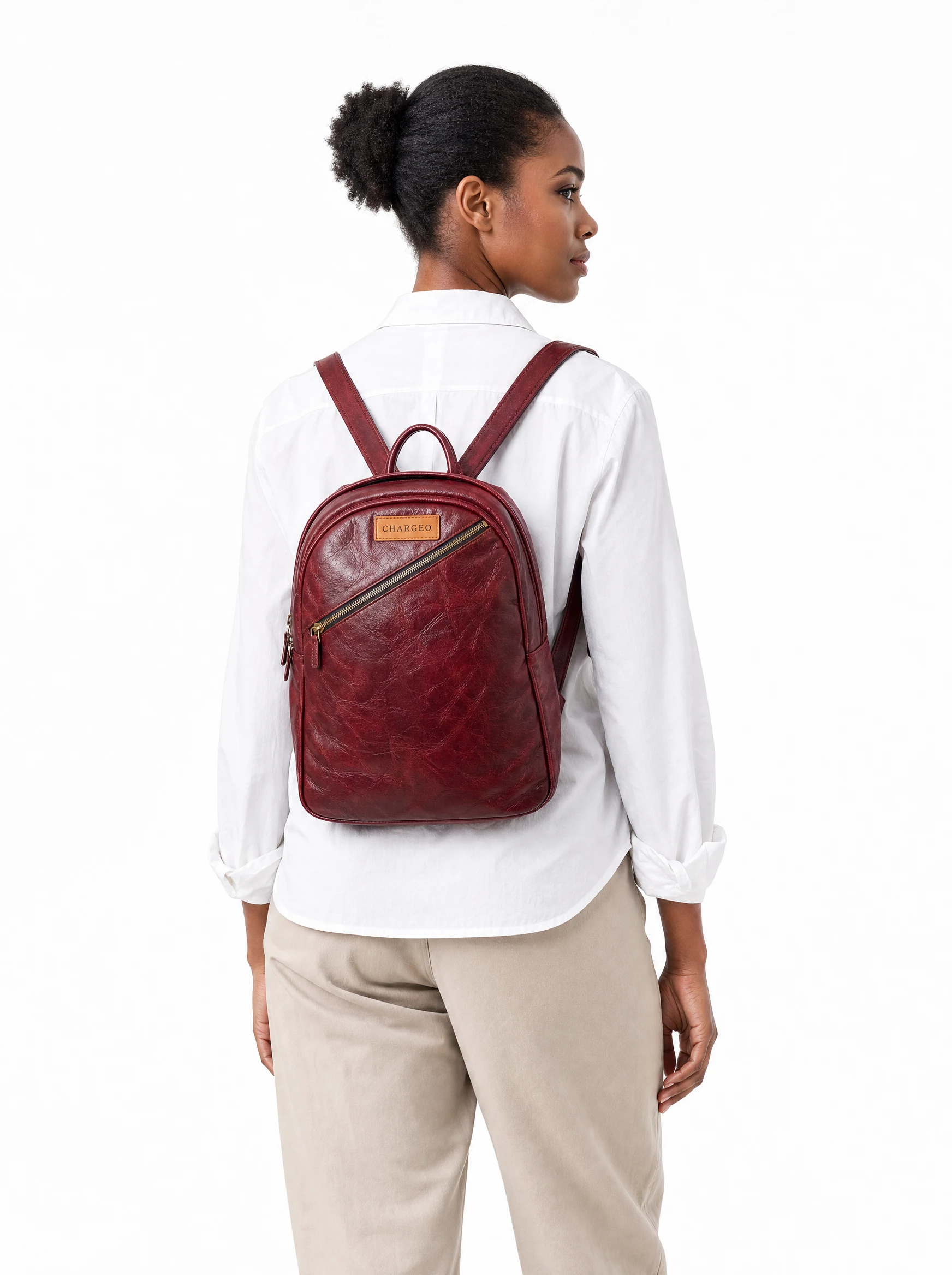
Each of our pieces arrives with a silk dust bag. Our leather backpacks are cut from full-grain leather that is oil coated, so a dry cloth is enough most weeks.
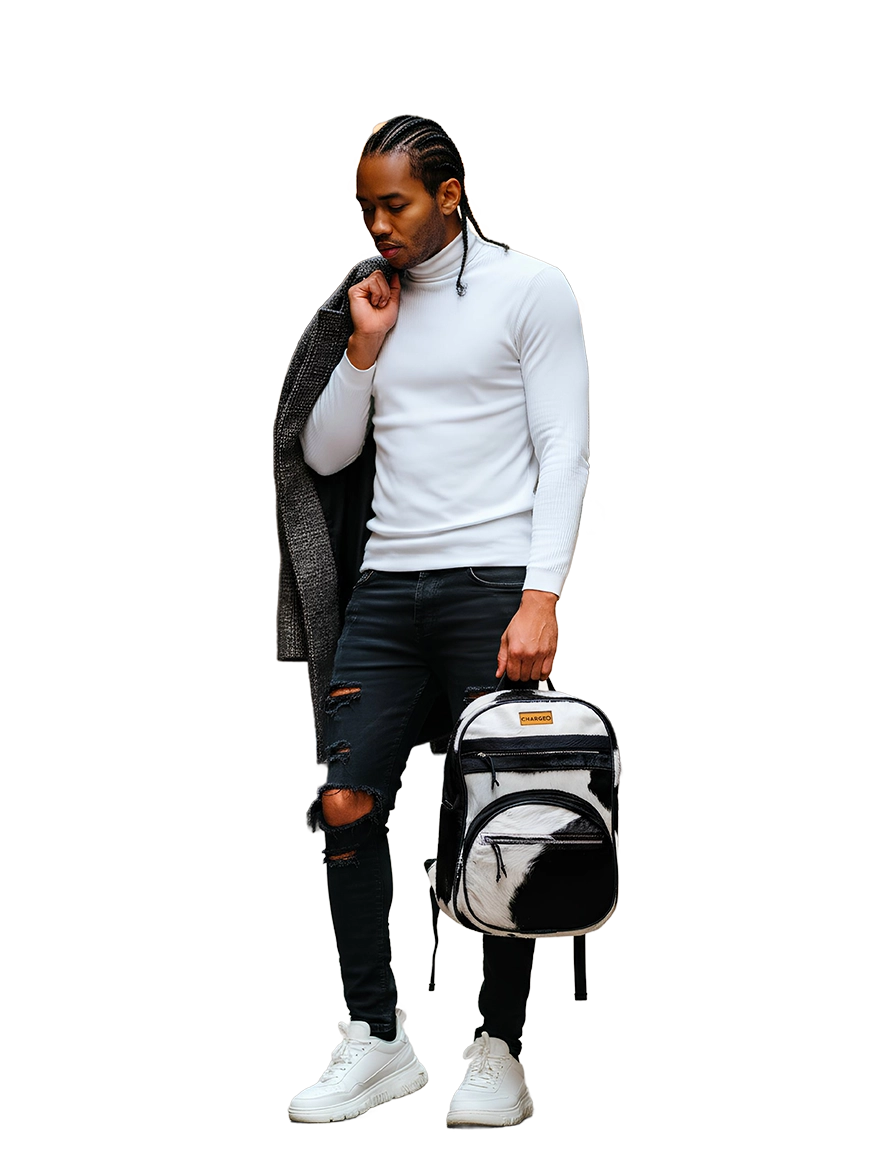
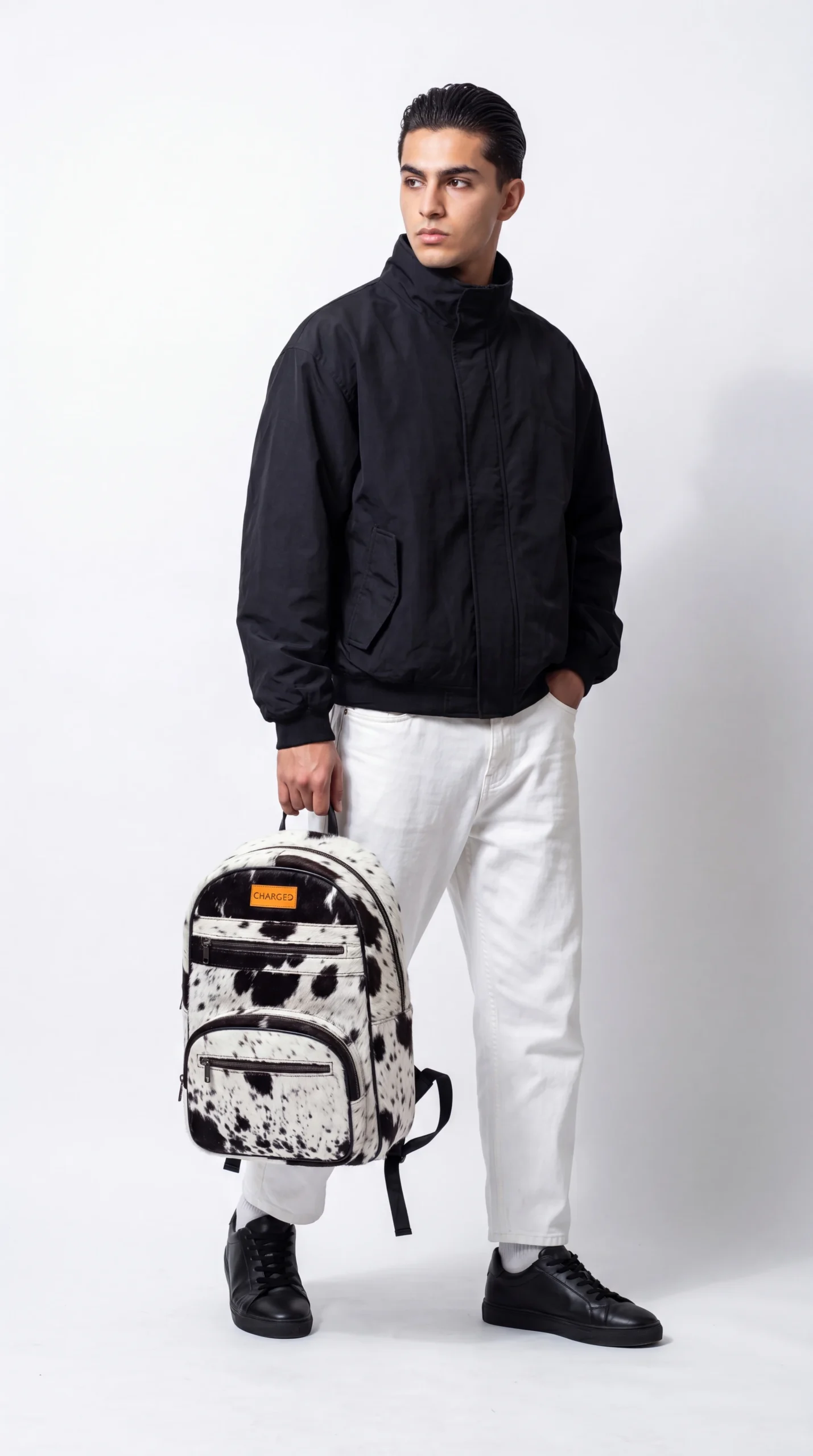
Exotic leathers and hair-on-hide need lighter care. For the hair side of a Zulu Treasure Leather Backpack, wipe gently with a damp cloth in the direction of the hair, and use no conditioner there. See our pages on crocodile leather belts and ostrich leather, our guide to the types of leather, and how we choose sustainably sourced leather.
Before you buy, read what to look for in a leather backpack, or see all our leather backpacks.


More on Leather Backpacks
Questions, Answered
What is the best way to clean a leather bag?
Wipe it with a soft dry cloth, lift marks with a barely damp cloth, and let it dry in the air at room temperature.
What household products can you use to clean leather?
Clean water on a barely damp cloth is the only household product we advise. Avoid vinegar, baking soda, baby wipes, alcohol and cleaners with bleach or ammonia.
How often should you condition a leather bag?
Two or three times a year, with a light coat of conditioner made for smooth leather.
Is saddle soap good for a leather bag?
We would keep saddle soap for boots and saddles. On a full-grain leather bag we advise clean water on a barely damp cloth, then a conditioner made for smooth leather.
How do you make a leather bag look new again?
Clean it, let it dry, then condition it and buff it with a dry cloth. Scuffs, loose stitching and faded colour are work for a repairer.
What is a good solution to clean a leather bag?
Clean water, on a cloth that is barely damp. We advise no soap, vinegar or household cleaner on full-grain leather. For ink, grease and dye, the safe solution is a repairer.
How often should you clean a leather bag?
Wipe a bag in daily use with a dry cloth once a week, clean the handles and corners with a barely damp cloth once a month, and condition it two or three times a year.
How do you get ink out of a leather bag?
Blot a wet mark once with a dry cloth and stop there. We would not use alcohol, hairspray or nail varnish remover on leather, so we advise taking the bag to a repairer.
Read all our questions and answers