


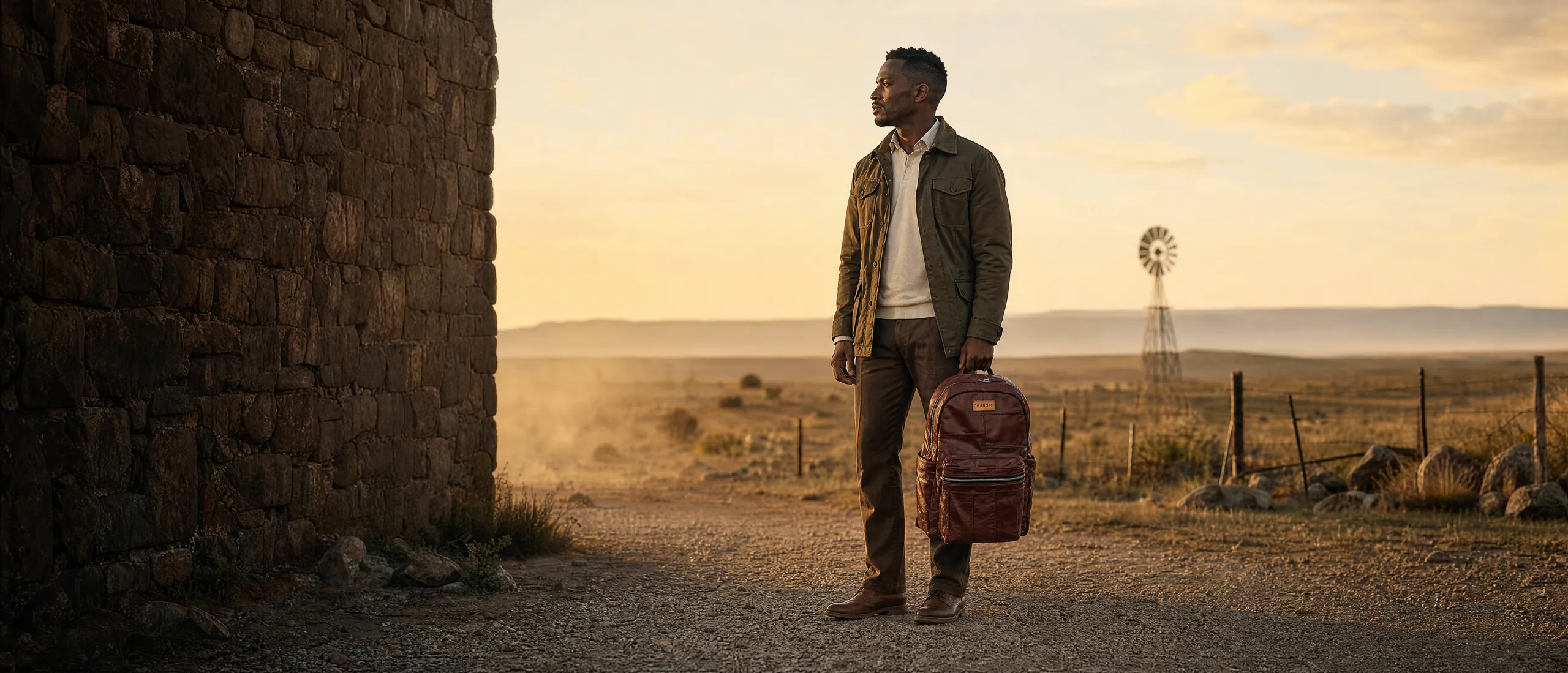
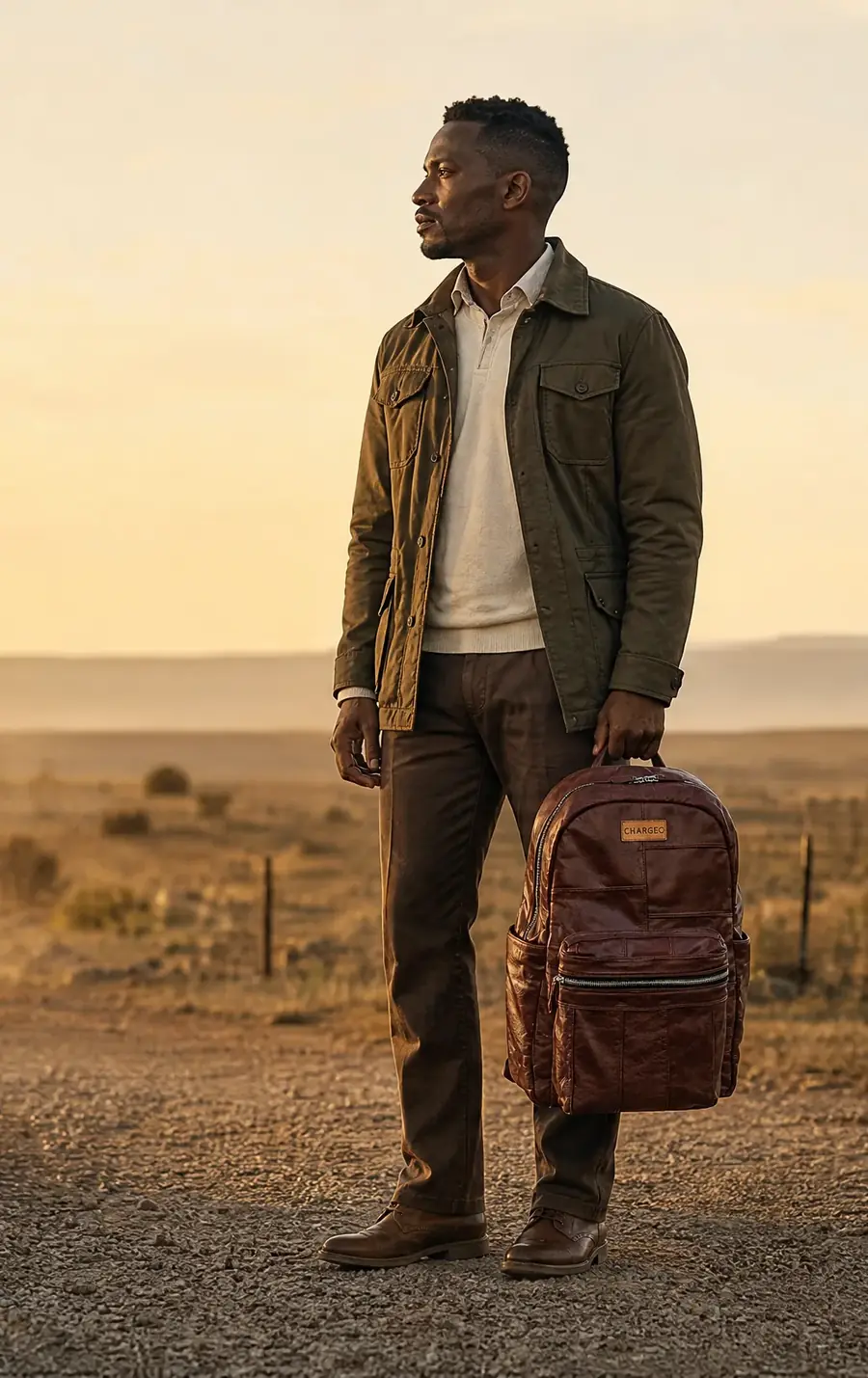
Leather can be a sustainable choice when the hide is a by-product, the tannery is well run and the piece is kept and repaired. Is leather sustainable in every case? No. Livestock farming and tanning carry real environmental costs, and some hides are not by-products at all. We sell leather, so both sides are set out here before we say how we source ours.
When Is Leather a Sustainable Choice?
Leather is a sustainable choice when three things hold: the hide is a by-product, the tannery manages its waste, and you keep the piece for years. It is a poor choice when it is bought cheaply and replaced often. I think a bag kept for many years is better than several that are replaced.
Is Leather a By-Product of the Meat Industry?
For cattle, sheep, goats and pigs, yes. About 99 percent of leather comes from animals raised for food, according to the Leather Working Group. The trade body Leather Naturally puts the hide at 3 to 4 percent of the value of the animal to the farmer, so cattle are not raised for their hides.
The same case cannot be made for every exotic leather. For ostrich, in figures from 2003, leather made up about 65 percent of South African export earnings from the bird, so the skin is a main product. By that first test our ostrich and crocodile belts are not by-product leather. Their case rests on traceable farms and on being made to order.
What Are the Criticisms of Leather?
The main criticisms of leather are the impact of livestock farming and the chemicals used in tanning. Rearing livestock at scale is linked to deforestation, overuse of water and land, and gas emissions. Chrome tanning produces waste that pollutes where it is badly managed.
These are fair points. A buyer who wants no part in livestock farming should not buy leather.

What Is the Carbon Footprint of Leather?
The carbon footprint of leather has no single agreed figure, because the answer depends on how much of the animal’s footprint is counted against the hide.
Begin with the animal. In a report published in 2013, the Food and Agriculture Organization of the United Nations estimated that livestock supply chains emit 7.1 gigatonnes of carbon dioxide equivalent a year, or 14.5 percent of all human-induced greenhouse gas emissions. The estimate is for 2005, the report’s reference year. Beef accounts for 41 percent of the sector’s emissions and cattle milk for 20 percent. Leather comes out of the same system, so the question is what share belongs to it.
A review published in 2017 by the United Nations Industrial Development Organization sets out the two positions. If hides are treated as waste of the meat and milk industries, the whole environmental impact is allocated to the milk and the meat, and farming falls outside the calculation for leather. If hides are treated as a by-product or a co-product, some argue that part of the farm’s impact belongs to them. An analysis from 2012, reprinted in the review, found no single method agreed internationally. The review goes on to describe a European standard published in March 2017, EN 16887, which starts the count at the slaughterhouse floor and ends it at the tannery gate. It expects that standard to prevail and says many issues remain unresolved.
The choice changes the figure several times over. The review cites studies in which the footprint of the same leather article varies between 35 and 320 kilograms per square metre, depending on where the boundaries are set. One chart it reproduces puts leather at 110 kilograms of carbon dioxide equivalent per square metre with cattle farming included, and at 17 kilograms when the count starts after the slaughterhouse. The Wikipedia article on leather gives a range of 65 to 150 kilograms of carbon dioxide equivalent per square metre for bovine leather.
Figures also move when the data are revised, and it matters who revised them. The Leather Working Group, an industry body funded by its members, reports that a dataset for bovine leather which it submitted with the trade body Leather Naturally was added in October 2024 to the Higg MSI, an index of material impacts. The new dataset put the stated impacts between 55 and 67 percent lower than the previous values.
My reading is that a single figure for leather tells you the method used as much as the impact. When a brand quotes one, ask where the count begins.
How Much Water and Chemistry Does Tanning Use?
Tanning uses a great deal of water and a long list of chemicals, and what matters to the environment is whether the tannery treats what it discharges.
The Wikipedia article on leather gives the scale: one ton of hide or skin generally produces 20 to 80 cubic metres of waste water, with chromium at 100 to 400 milligrams a litre. Treatment changes that. As an example of an efficient system, the same article gives chromium loads per tonne produced that are cut to 1.5 kilograms, down from 8.
The industry’s account is that treatment is now usual. Leather Naturally, a trade body, says that most tanneries run their own wastewater treatment plant or send their wastewater to an industrial or municipal one. The same factsheet says that chromium VI is not used in tanning and that proper processing removes the risk of its forming.
The critics’ account is that this does not hold everywhere. The Wikipedia article on tanning records that boiling and sun drying can convert the chromium compounds used in tanning into carcinogenic hexavalent chromium, and the article on leather notes that tanning is especially polluting in countries where environmental regulations are lax.
Both accounts can be true at once, of different tanneries. For that reason I put the tannery ahead of the tanning method, and an audit ahead of a word on a label.
Is Vegetable-Tanned Leather Better for the Environment?
Not by itself. Vegetable tanning avoids chromium, and it is much slower. It uses tannins from plants. Chrome tanning uses chromium salts and is the most common method today. A well-managed chrome tannery treats its waste, so the tannery matters as much as the method. The Wikipedia article on leather describes both methods.
Which Tanning Method Has the Lowest Environmental Impact?
No tanning method has a clear lead on the evidence I can cite: chrome, vegetable and chrome-free tanning each save in one place and cost in another.
| Method | In its favour | Against it |
|---|---|---|
| Chrome | At best practice it uses half the chemicals of the other methods, and its effluent falls below legal limits | The chromium in its waste has to be managed, and harm follows where it is not |
| Vegetable | Its tannins come from wood and nuts, which are natural and renewable | It uses a few times the amount of tanning material, usually takes longer, and its effluent needs more treatment before discharge |
| Chrome-free | It uses no chromium. The most common agent is glutaraldehyde | It needs relatively more chemicals after tanning, and its effluent needs additional treatment |
The table follows the tanning factsheet of Leather Naturally, a trade body, which concludes that there is little difference between the methods in environmental impact once all the variables are considered. The one entry that is not the factsheet’s is the case against chrome, which rests on the Wikipedia articles cited in the section above. A trade body speaks for its industry, and I read its conclusion with that in mind. I have found no independent comparison of the three methods to set beside it.
What I take from it is narrower. The word vegetable on a label does not by itself make a leather the greener choice. The same goes for eco-friendly leather, a term for which I know of no agreed definition. Ask what claim stands behind the word.
Our guide to the types of leather explains how each method works and what leather it gives.
What Is the Leather Working Group?
The Leather Working Group is a body that audits tanneries on how they manage and report their environmental impact. Its audit covers the tannery stage, where raw hide becomes finished leather. It does not audit farms or slaughterhouses. We make no claim here about audits of the tanneries we buy from.
Which Leather Certifications Might You See, and What Does Each Cover?
The marks a buyer is likely to meet cover four different things: how a tannery is run, which chemicals it may use, what is in the finished leather, and whether a protected species was traded under international controls.
| Mark | What it covers | What it leaves out |
|---|---|---|
| Leather Working Group rating | A tannery audit in 17 sections, among them water and energy use, chemical management, and waste management and effluent treatment. Gold needs 85 percent, Silver 75 and Bronze 65 | Farms and slaughterhouses |
| ZDHC | A list of chemical substances that are not allowed in chemical products for leather manufacture, as Leather Naturally describes it | Everything outside the chemistry |
| OEKO-TEX LEATHER STANDARD | Tests of the leather, thread and buttons against a list of over 1,000 harmful substances | How the animal was farmed |
| CITES documents | That a listed species such as crocodile was traded under the convention described further down this page | How the tannery performs |
The Leather Working Group is an industry body, funded by members that include brands and leather manufacturers, and one detail of its rating is easy to miss. The final medal is set by the lowest-scoring section, so a tannery rated Gold has reached 85 percent in every scored section.
Leather Naturally, the trade body, names other audit schemes as well, including national ones in Brazil and Italy. Whatever the scheme, the audit is of a tannery. Ask the brand which tannery made the leather, then look for that name on the list of certified suppliers the scheme publishes.

What Does Traceable Leather Mean?
Traceable leather is leather whose path can be followed back through the supply chain, and the claim is only as good as the point it reaches.
The Leather Working Group, the industry body that audits tanneries, assesses as part of that audit the proportion of material that is traceable to the slaughterhouse, to a group of slaughterhouses or to a point of collection. It recognises four types.
- Physical. A stamp or laser mark on the hide leads to one slaughterhouse.
- Documented. Paperwork leads to one slaughterhouse.
- Group. The hide can be tied to a group of slaughterhouses.
- Regional. The hide can be tied to a point of collection, where slaughter is informal.
The group adds that the traceability score does not at present decide a tannery’s medal, and that it plans to change this.
Notice what is measured: the path to the slaughterhouse. The farm is a further step back, and the group itself names deforestation and animal welfare, which are questions about farms, among the reasons for tracing leather at all. So I would put four requests to a brand.
- Say how far back the claim reaches: the tannery, the slaughterhouse or the farm.
- Say whether it rests on a mark on the hide or on paperwork.
- Say who checked it, and when.
- Name the country and the region the hide came from.
A brand that knows can answer each in a sentence. I would treat a vague answer as a no.
Do Cows Need to Be Killed for Leather?
Yes. Leather comes from animals that have been slaughtered, and almost all cattle are raised for meat or dairy. The hide is taken afterwards. The Leather Working Group says unused hides would go to waste.
Can You Be Vegan and Still Wear Leather?
No, by the usual meaning of the word. Veganism excludes animal products, and leather is one. Some people who avoid new leather still wear leather they already own or buy second-hand, and that is a personal choice.
How Does CITES Control Exotic Leathers Such as Crocodile?
CITES controls exotic leathers by listing species in appendices that set how tightly international trade in each is controlled. It is the Convention on International Trade in Endangered Species of Wild Fauna and Flora, in force since 1 July 1975, and its aim is to ensure that international trade does not threaten the survival of the species in the wild.
In the summary given by Wikipedia, Appendix I holds species that are threatened with extinction, and they receive the highest level of protection. Appendix II holds species that are not necessarily threatened with extinction but whose trade must be controlled.
The two exotic leathers on this site fall differently. Species+, the database developed by UNEP-WCMC and the CITES Secretariat, records the Nile crocodile as included in Appendix I except for named populations, and the population of South Africa is among those included in Appendix II. For the ostrich, only the populations of twelve named African countries are included in Appendix I, and no other population is included in the Appendices. South Africa is not one of the twelve.
A listing is a control on trade. It says nothing by itself about how a farm is run, and it is no mark of environmental quality. Our page on crocodile leather belts covers what the listing means for a belt that crosses a border. Ask any seller of a listed skin where it was farmed and which documents come with it.
What Is a Sustainable Alternative to Leather?
The common alternatives to leather are artificial leathers, which are usually polyurethane or vinyl coated on a cloth backing. Ask of any material the three questions you would ask of leather: what it is made from, how it is made, and how long you will keep it.

Does Leather or Synthetic Leather Have the Lower Impact Over Its Life?
Neither wins on every count, and the evidence is incomplete. On the figures I can source, a synthetic carries the lower footprint when it is made, and the case for leather rests on how long it is kept, for which I have found no measurement.
Making. A presentation reproduced in the UNIDO review of leather’s carbon footprint gives artificial leather 15.8 kilograms of carbon dioxide equivalent per square metre, incineration included. A chart in the same review, drawn from the same presenter, gives leather 17 kilograms counted after the slaughterhouse, and 110 with cattle farming included. On those figures the synthetic is lower either way, narrowly by one count and by a wide margin on the other. The review does not say whether the leather figures include disposal, so the two are not strictly like for like.
Materials. Synthetics are usually oil-based, made with polyester or nylon and coated with PVC or PU, in the words of Leather Naturally, the leather trade body. It says the newer plant-based materials are often combined with or backed by the same two plastics. The Wikipedia article on artificial leather adds that PVC needs a phthalate plasticiser to make it soft, and that in a landfill it does not decompose as leather does and can release chemicals such as dioxins.
Microplastics. The Wikipedia article on microplastics records that plastic fibres enter the environment through wear and tear and through the washing of synthetic clothing. That evidence concerns clothing that is laundered. I have found no measurement for the coated materials used in bags, so I make no claim about them.
Use. Here I can offer a view and no figure. A leather bag can be restitched, recoloured and relined, as our page on leather bag repair sets out. Leather Naturally says synthetic leather is difficult to repair, which is what a trade body for leather would be expected to say, and I have no independent study of how long either material is kept in use.
So the comparison turns on years of use, which no label states. Divide the footprint by the years you expect to carry the piece. On the making figures above, a leather bag discarded as soon as a synthetic one would carry the higher footprint of the two.
Is Leather Biodegradable?
Leather does break down, but slowly, because tanning exists to stop a hide from rotting. The international definition of leather, as the trade body Leather Naturally quotes it, is a hide or skin tanned to be imputrescible.
The Wikipedia article on leather puts the result in years: leather takes 25 to 40 years to decompose, against about six months for cotton clothing and hundreds of years or more for plastics.
Treat that as a rough guide. A finished bag is more than hide. The surface coating, the thread, the lining, the zip and the metal fittings each break down at their own rate, or not at all, and I have no figure for a whole bag.
I would not buy leather on the grounds that it is biodegradable. The better argument comes before the bin, and it is to keep the piece in use.
What Can a Buyer Do to Choose Leather Responsibly?
A buyer chooses leather responsibly by buying less of it, asking where it came from and keeping it in use. We sell new leather, and I would still rank the choices in this order.
- Keep and repair what you own.
- Buy second-hand. A bag that already exists calls for no new hide, no new tanning and no new making.
- Buy new, buy once and keep it.
If you buy second-hand, check the bag before you pay. Bend a panel to see that the leather flexes without cracking. Smell the lining for mould. Then look at the seams, the zip and the handles, and allow for the repair they may need. Our leather care guide covers the cleaning that a bag from another owner will want.
If you buy new, these are the questions I would ask, and the habits that follow.
- Which animal is the leather, and is the hide a by-product of food.
- Which tannery made it, whether that tannery has been audited, and by whom.
- How far back the hide can be traced.
- For an exotic skin, where it was farmed and which papers come with it.
- Prefer a piece made to order, or made in a small run, to one made for stock that may never sell.
- Choose the piece you expect to carry for years, then clean it, condition it and store it properly.
- When you have finished with it, sell it or give it away.
Answers matter more than labels. A seller who cannot say which tannery made the leather, or how far back the hide can be traced, has told you what you needed to know, and deciding not to buy is a fair conclusion.
How Do We Source Our Leather?
We source our leather in South Africa, and every hide is traceable to a certified farm. That applies to our full-grain bovine leather, our ostrich and our crocodile. Our bovine leather comes from South African tanneries.
- Made to order. Our leather backpacks and belts are made after you commission them, so none is made and left unsold.
- Offcuts used. The Sahara Crocodile-Embossed Leather Belt is made from leather offcuts sourced in South Africa.
- Repaired by us. See our repair service.
Read about each hide: full-grain leather, ostrich leather and crocodile leather belts. Our guide to the types of leather covers all of them, and our leather care guide shows how to keep a piece.
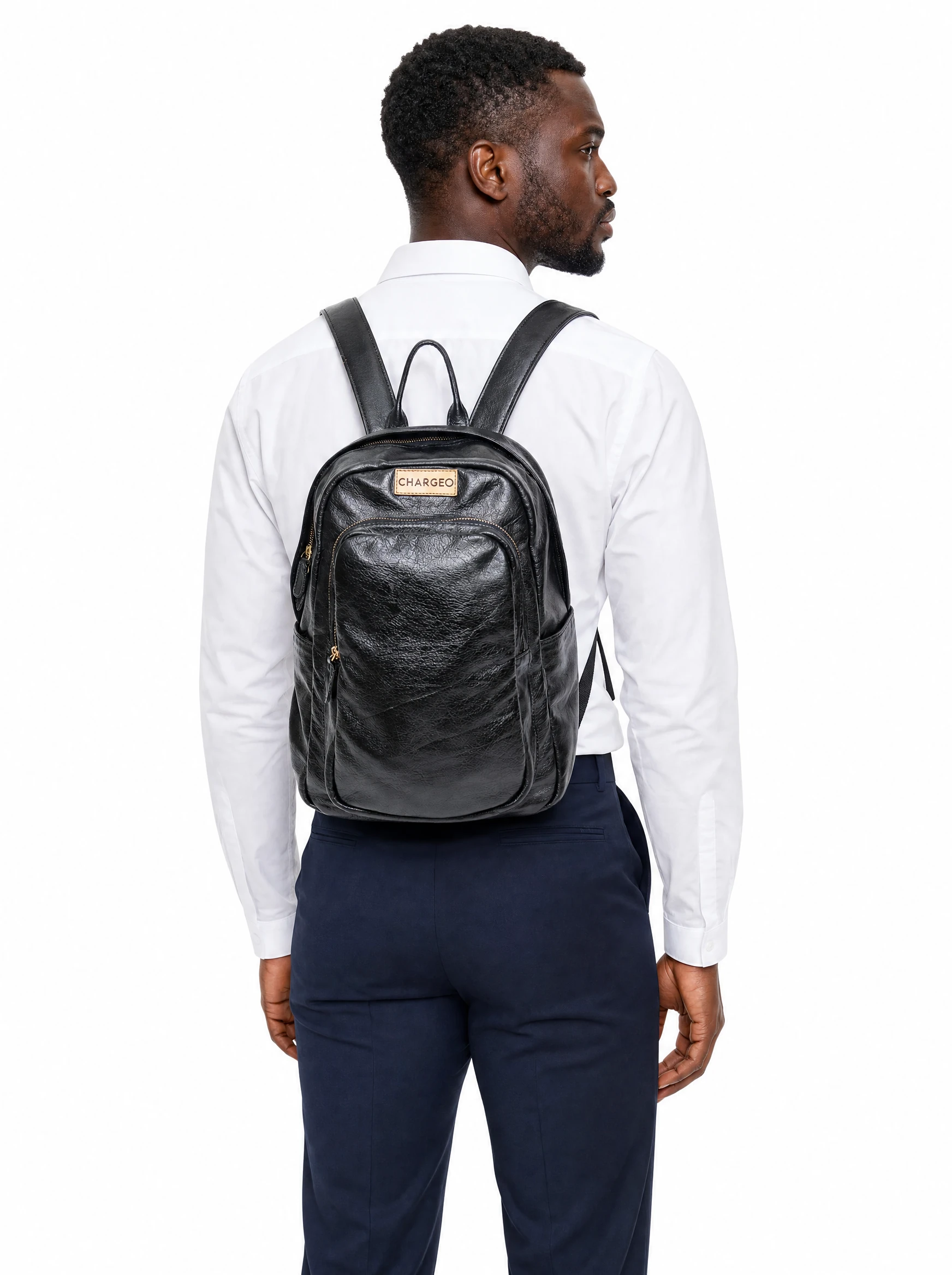


More on Hides and Leathers
Questions, Answered
Is leather sustainable?
It can be, when the hide is a by-product, the tannery is well run and the piece is kept and repaired. It is a poor choice when bought cheaply and replaced often.
Do cows need to be killed for leather?
Yes. Leather comes from animals that have been slaughtered, and almost all cattle are raised for meat or dairy. The hide is taken afterwards.
Is leather a by-product?
For cattle, sheep, goats and pigs, yes. About 99 percent of leather comes from animals raised for food. The same case cannot be made for every exotic leather.
Can you be vegan and still wear leather?
No, by the usual meaning of the word. Veganism excludes animal products, and leather is one.
Where does CHARGEO source its leather?
In South Africa. Every hide is traceable to a certified farm, and our bovine leather comes from South African tanneries.
What is a sustainable alternative to leather?
The common alternatives are artificial leathers, usually polyurethane or vinyl on a cloth backing. The trade body Leather Naturally says newer plant-based materials are often backed with the same plastics. Second-hand leather is the alternative we would rank first.
What is eco-friendly leather?
We know of no agreed definition. The term is used for vegetable-tanned, chrome-free or audited leather. Ask which tannery made it, whether that tannery was audited, and how far back the hide can be traced.
What is the carbon footprint of leather?
There is no single agreed figure. One chart reproduced in a 2017 United Nations Industrial Development Organization review gives 110 kilograms of carbon dioxide equivalent per square metre when cattle farming is counted, and 17 kilograms when the count starts after the slaughterhouse.
Read all our questions and answers


