








Ostrich leather is the tanned skin of the ostrich. It is known by its quill marks, the raised points left where each feather grew. It is real leather and is classed as an exotic leather. The rest of this page explains the quills, how leg leather differs from the body hide, how skins are graded and how to tell a genuine one.
What Is Ostrich Leather Made From?
Ostrich leather is made from the skin of the ostrich. Its surface is smooth, with raised bumps. The bumps are the empty follicles where the feathers grew.
Is Ostrich Leather Real Leather?
Yes. Ostrich leather is real leather. It is tanned as a cattle hide is, and it is classed with crocodile as an exotic leather because it does not come from cattle, sheep, goats or pigs. Our guide to the types of leather shows how it is classed.
What Are the Quill Marks on Ostrich Leather?
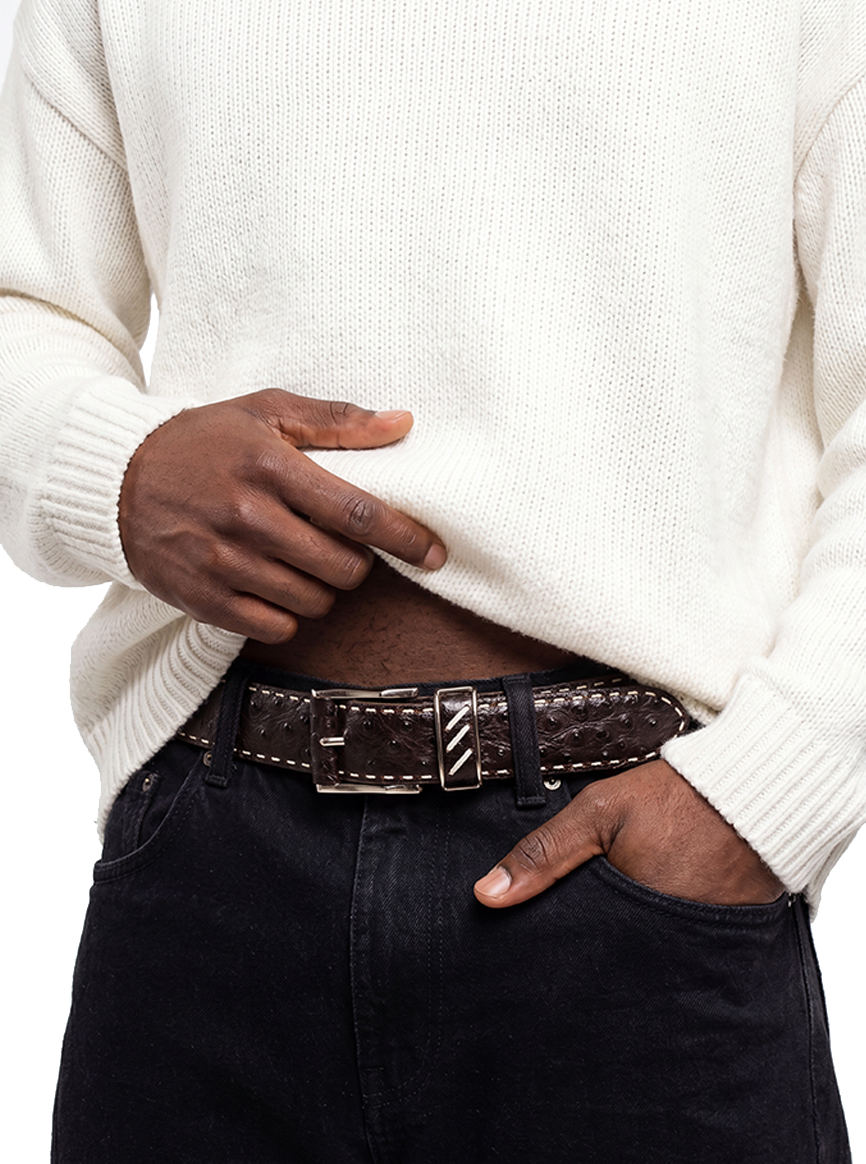
The quill marks are feather follicles. They sit in a diamond-shaped area in the centre of the skin, which the trade calls the crown. Only about a third of an ostrich skin carries quills, and the sides are smooth.

Ostrich Leg or Ostrich Hide: What Is the Difference?
Ostrich leg leather comes from the lower leg and carries a line of scales. Ostrich hide comes from the body and has the quills.
| Ostrich leg | Ostrich hide | |
|---|---|---|
| Comes from | The lower leg | The body, chiefly the crown |
| Surface | Scales in a line | Raised quill marks |
| Panel size | Narrow | Wide |
Full Quill, Smooth or Leg: How Do the Three Compare?
Full quill is cut from the crown and carries the quills, smooth ostrich comes from the sides of the same skin, and leg leather comes from the lower leg and carries scales. The last column of the table is my own advice.
| Type | Part of the bird | Surface | What I would use it for |
|---|---|---|---|
| Full quill | The crown, on the back, where the neck meets the body | Raised quill marks across the whole face | A piece where the quill is the point: a belt, a wallet, the front of a bag |
| Smooth | The skin to the left and right of the crown | Quite smooth, with few quills or none | Linings, gussets and the backs of pieces |
| Leg | The tarsus, the lowest upright part of the leg, which is covered in scales | A line of broad scales | Belts and other narrow pieces |
The leg sets its own limit. The tarsus measures 39 to 53 cm in length, which is shorter than a belt, so ask any maker how a full-length belt is cut from it.
A label should follow the part. I read full quill to mean that quills cover the whole face of the piece, and I would question the term on a piece that shows smooth patches.
How Is Ostrich Leather Graded?
Ostrich leather is graded on scars, blemishes and how well the quills have formed. A hole, a scratch or a healed wound lowers the grade. South African tanned skins are also sorted into size classes.
Ostrich leather drew between 320 and 590 searches a month in South Africa, highest in April and August 2026.
Searches for Ostrich Leather
Searches a month, September 2025 to August 2026
- Searches for “ostrich leather”
What Lowers the Grade of an Ostrich Skin?
Scars and blemishes lower the grade of an ostrich skin first, and poorly developed follicles and a skin deemed too small bring further penalties.
A skin is graded more than once: as a green skin, as crust and as finished leather. The grade sets what the farmer is paid as well as what the buyer pays. Beside holes and scratches, the defects counted include a loose scab and bacterial damage.
Quill quality is the looser half of the standard. Definitions of acceptable follicle size and style are vague, and often the subjective opinion of the tanner or buyer. Follicles thin out further away from the neck, and how well they develop depends on the maturity of the bird at slaughter.
A grade is therefore a judgement, and two tanneries may not mean the same thing by it. Judge the panel in front of you: even quills, no flat patches, and no scar across the face.
Why Is Ostrich Leather So Expensive?
Ostrich leather is expensive because the quilled crown is only about a third of the skin, and each skin is graded for flaws. A panel cut wholly from a clean crown costs the most.
Where Does Ostrich Leather Come From?
In 2003 South Africa supplied 79 percent of the ostrich skins in the world. In the 1990s Oudtshoorn, in the Klein Karoo, accounted for about three quarters of South African ostrich production. Those are the most recent figures we could verify. Our page on how we source leather covers our own ostrich.

How Did Ostrich Farming Begin in the Klein Karoo?
Ostrich farming in the Klein Karoo began with feathers, and leather came more than a century later. Commercial farming started at Oudtshoorn in the 1850s, when farmers saw the value of ostrich feathers for fashionable hats.
Oudtshoorn had its feather booms during 1865 to 1870 and 1900 to 1914. Before the First World War ostrich feathers were outranked only by gold, diamonds and wool among South African exports. The market collapsed in 1914. Eight in ten ostrich farmers were bankrupted, and domesticated ostriches fell from 314,000 at the end of the war to 32,000 by 1930.
Rebuilding took decades. A cooperative of Klein Karoo farmers was set up in 1945 to restore the industry. It built the first ostrich abattoir in the world in 1963 and 1964, and the first ostrich skin tannery opened there in 1970. Until then very little was known about tanning the skin. After 1993 the South African government permitted the export of ostrich stock, and other countries began to raise ostriches of their own.
How Is Ostrich Skin Tanned and Finished?
Ostrich skin is tanned in three stages, called raw, crust and finished, and it is put through more than 30 steps. The steps below are counted as that article counts them.
- Raw. The skin is soaked, cleaned, fleshed, pickled and trimmed, then chrome-tanned with chromium sulphate and other chromium salts. The fifteenth step leaves the tanned skin the trade calls wet blue.
- Crust. Ten steps of trimming, dyeing and drying follow. The skin is measured once it is dry.
- Finished. Eleven steps begin with conditioning to soften the skin and end with grading, measuring and packing.
The same account says that the pigment of the bird is bleached out of the skin along the way, and that the hide then receives its colours and finishing dyes. The skin is also small:a prepared skin averages about 1.5 square metres, and is handled in small batches, much as goat and sheep skins are.
Wet blue, crust and the other tannery terms are defined in our guide to the types of leather.
What Is Ostrich Leather Used For?
Ostrich leather is used mainly for boots, handbags and belts, and for the seats and trim of cars and motorcycles.
Boots are by far the most widely used application, and many are bought with a matching belt. Handbags and jackets carry the highest prices, because of the amount of leather they need. In cars, seats, dashboards and door panels can be covered or accented with ostrich leather.
Most South African ostrich leather leaves the country. South African tanneries export around 90 percent of their finished leather to manufacturers in Europe and East Asia, where it becomes gloves, wallets, handbags, shoes, luggage, upholstery and sports goods. Taste differs by market: Japan has an especially active market for ladies’ handbags, and the southern United States for boots.
Whether ostrich is a responsible choice is a separate question, and our page on whether leather is sustainable sets out both sides.
How Do You Tell Genuine Ostrich Leather?
You tell genuine ostrich leather by its quills. Check three things.
- Look at the spacing. Real quills vary in size and sit unevenly.
- Look for the edge of the crown. On a real skin the quills thin out towards the sides.
- Read the materials line. It should say ostrich, not ostrich print or ostrich effect.
What Should You Ask Before You Buy Ostrich Leather?
Ask which part of the skin the piece is cut from, whether it is ostrich or a print, and how it was joined and lined.
- Which part is it. Full quill, smooth or leg. All three are ostrich, but they are not the same leather.
- Is it ostrich or ostrich print. A print is cattle hide with the pattern pressed in. It is real leather, but it is not ostrich.
- Is each quill a follicle. Ostrich leather is known by its pattern of vacant quill follicles. Each raised point should show the small opening the feather left.
- Which colour and finish. For a first ostrich piece I would choose black, brown or tan, and keep a bolder colour such as blue for a small piece like a belt. Ask whether the finish is matt or polished, and look at the colour in daylight.
- How was it joined and lined. Ask where the joins fall and what the lining is.
- Where is it from. Ask where the bird was farmed and where the skin was tanned.
If you cannot handle the piece, ask the seller to photograph one quill at close range, and the back of the leather.

How Do You Care for Ostrich Leather?
Keep ostrich leather away from prolonged direct sun and from moisture. Wipe it with a soft, dry cloth and use no household cleaner on it. It stays supple with light, regular care. For smooth leather, see our leather care guide.
Can Ostrich Leather Get Wet?
Ostrich leather can take a few drops of rain, but we advise keeping it out of a soaking.
If it does get wet, blot it with a soft, dry cloth and do not rub. Let it dry at room temperature. We advise against sun, heaters and hairdryers for drying any leather.
Between wears, our advice is this:
- Handle it with clean, dry hands.
- Keep alcohol and hand sanitiser away from it.
- If you condition it, use a product made for exotic leather, a little at a time, and test it first where it will not show.
- Store it in a cloth dust bag, never in plastic. Hang a belt by the buckle or coil it loosely.
Is Ostrich Leather Covered by CITES?
The CITES listing for the ostrich covers the populations of twelve named countries, and South Africa is not among them. The entry in Species+, the species database developed by UNEP-WCMC and the CITES Secretariat, reads that only the populations of Algeria, Burkina Faso, Cameroon, the Central African Republic, Chad, Mali, Mauritania, Morocco, Niger, Nigeria, Senegal and Sudan are included in Appendix I, and that no other population is included in the appendices.
Crocodile is listed differently, and our page on crocodile leather belts covers its permits. This is general information and not legal advice. A country may set import rules of its own, so ask its customs service before you ship an ostrich piece or travel with one.
Which Ostrich Pieces Do We Make?
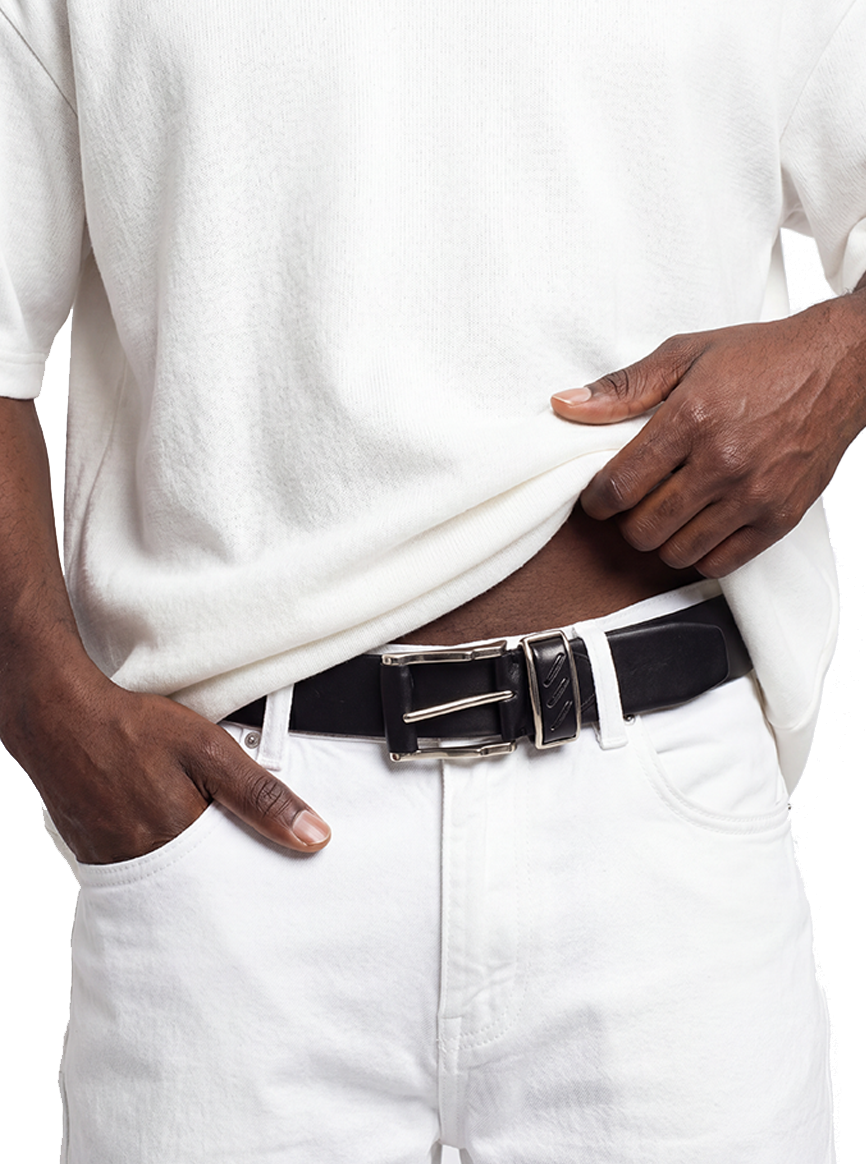
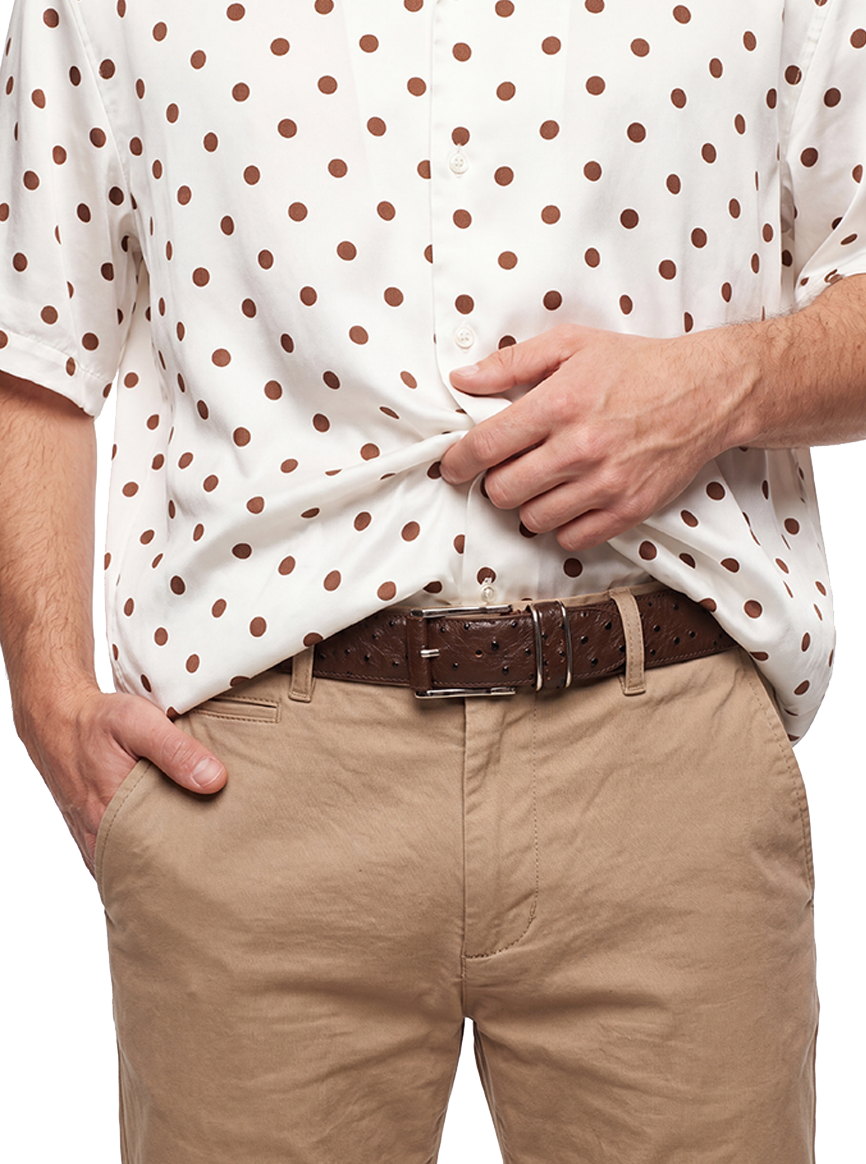
Our ostrich pieces are belts, and the ostrich is sourced in South Africa. Each belt is made to order in the size you choose.
| Leather belt | Leather | Price |
|---|---|---|
| Serengeti Ostrich Leg Belt, in Brown or Black | Ostrich leg | R3,900 |
| Blue Serengeti Ostrich Leg Belt | Ostrich leg | R4,500 |
| Tan Serengeti Ostrich Leg Belt | Ostrich leg | R4,500 |
| Kruger Ostrich Hide Belt | Ostrich hide, with the quill | R4,500 |
See all our leather belts. We have also written about Nguni hide, crocodile leather belts and full-grain leather.
More on Hides and Leathers
Questions, Answered
Is ostrich leather real leather?
Yes. It is the tanned skin of the ostrich, and it is classed as an exotic leather.
Why is ostrich skin so expensive?
The quilled crown is only about a third of the skin, and each skin is graded for scars, blemishes and poorly formed quills.
What are the bumps on ostrich leather?
They are quill marks: the empty follicles where the feathers grew.
Where to buy ostrich leather in South Africa?
From a maker who names the leather in the materials line. Our ostrich belts are made to order from ostrich sourced in South Africa.
What is ostrich leg leather?
Leather from the lower leg of the ostrich. It carries a line of scales and no quills.
Is ostrich leather legal?
The CITES listing for the ostrich covers only the populations of twelve named African countries, and South Africa is not among them. A country may set import rules of its own, so ask its customs service before you ship a piece. This is general information and not legal advice.
How much is ostrich leather?
It depends on the part of the skin and its grade. Full quill cut from a clean crown costs the most. Our ostrich belts are R3,900 to R4,500.
What is ostrich leather used for?
Mainly boots, handbags and belts, and the seats and trim of cars and motorcycles. It is also made into wallets, shoes, jackets, gloves and luggage.
Read all our questions and answers