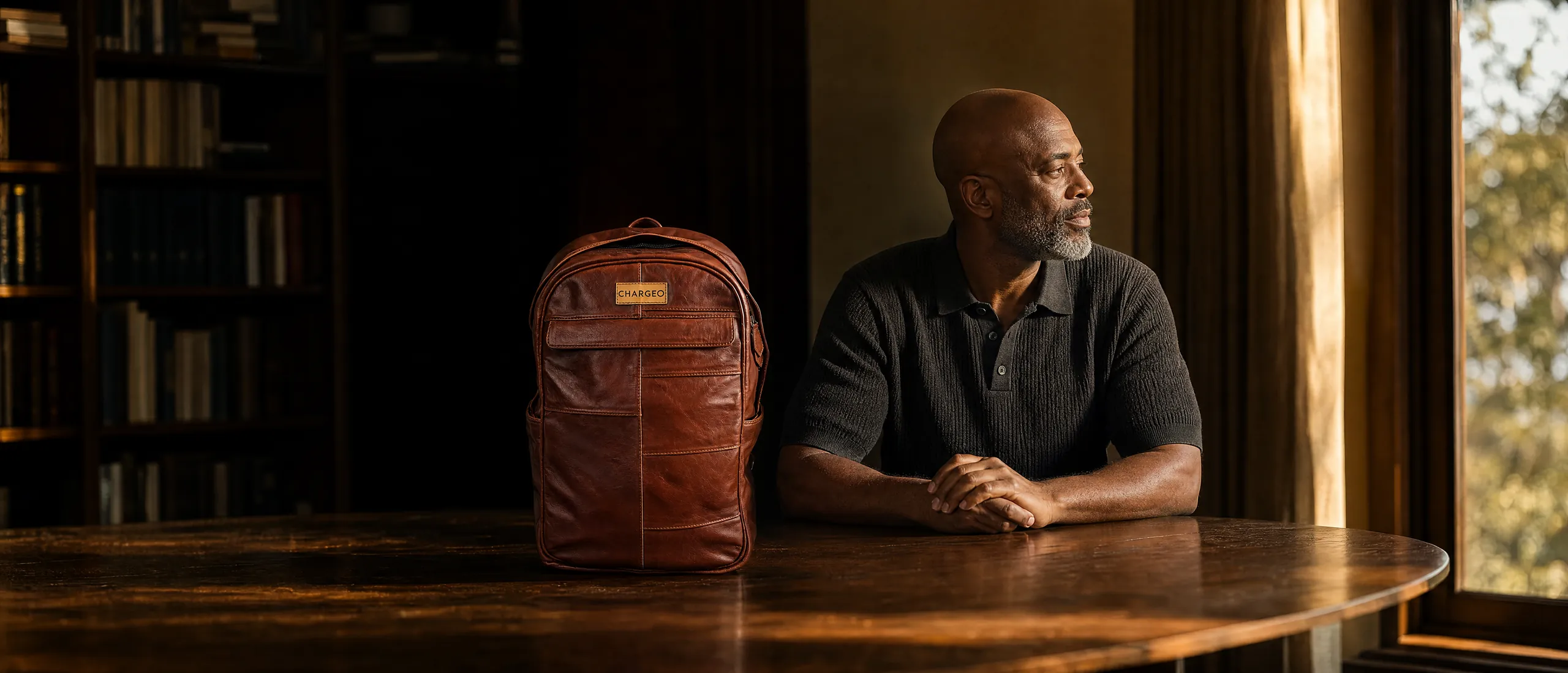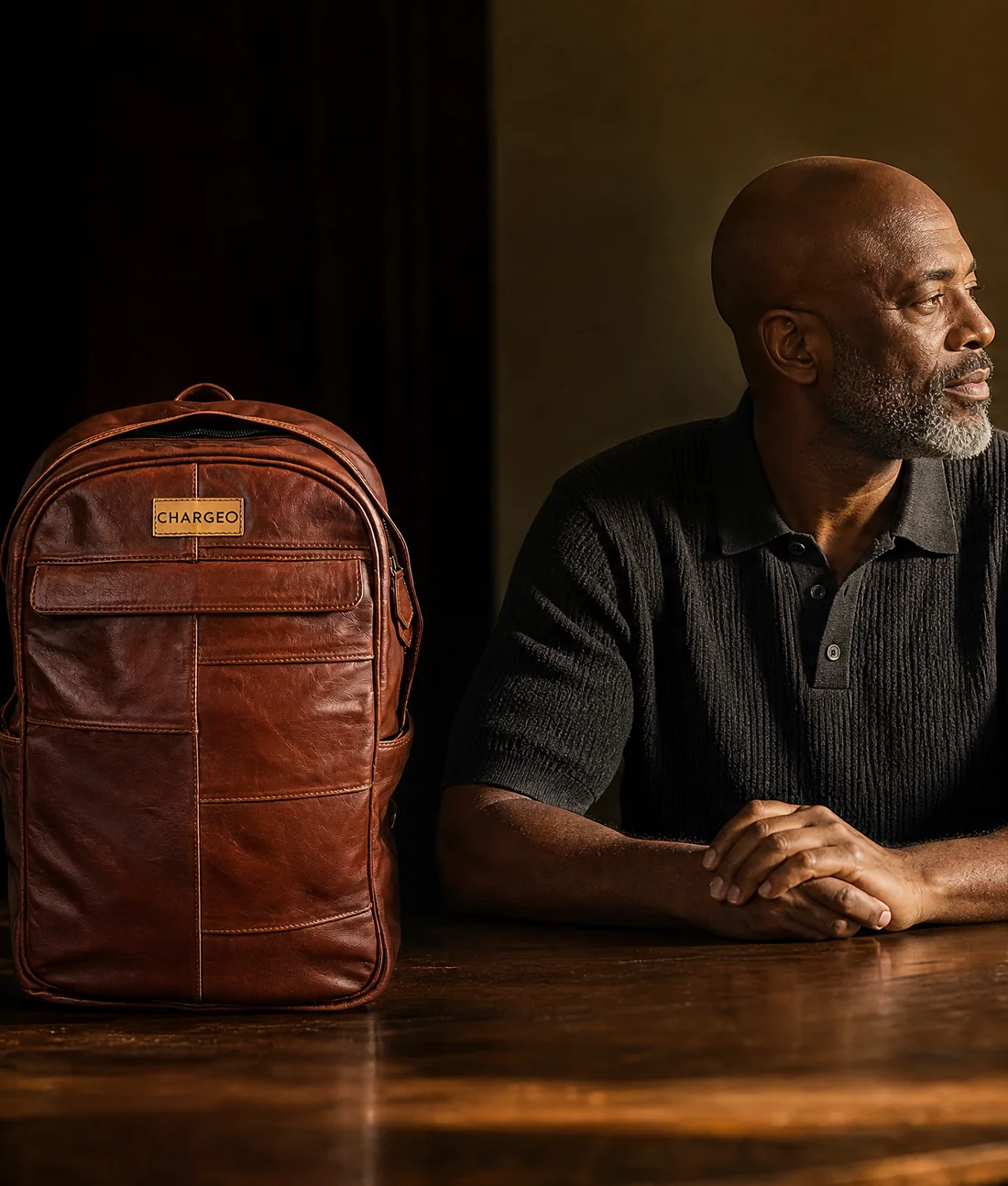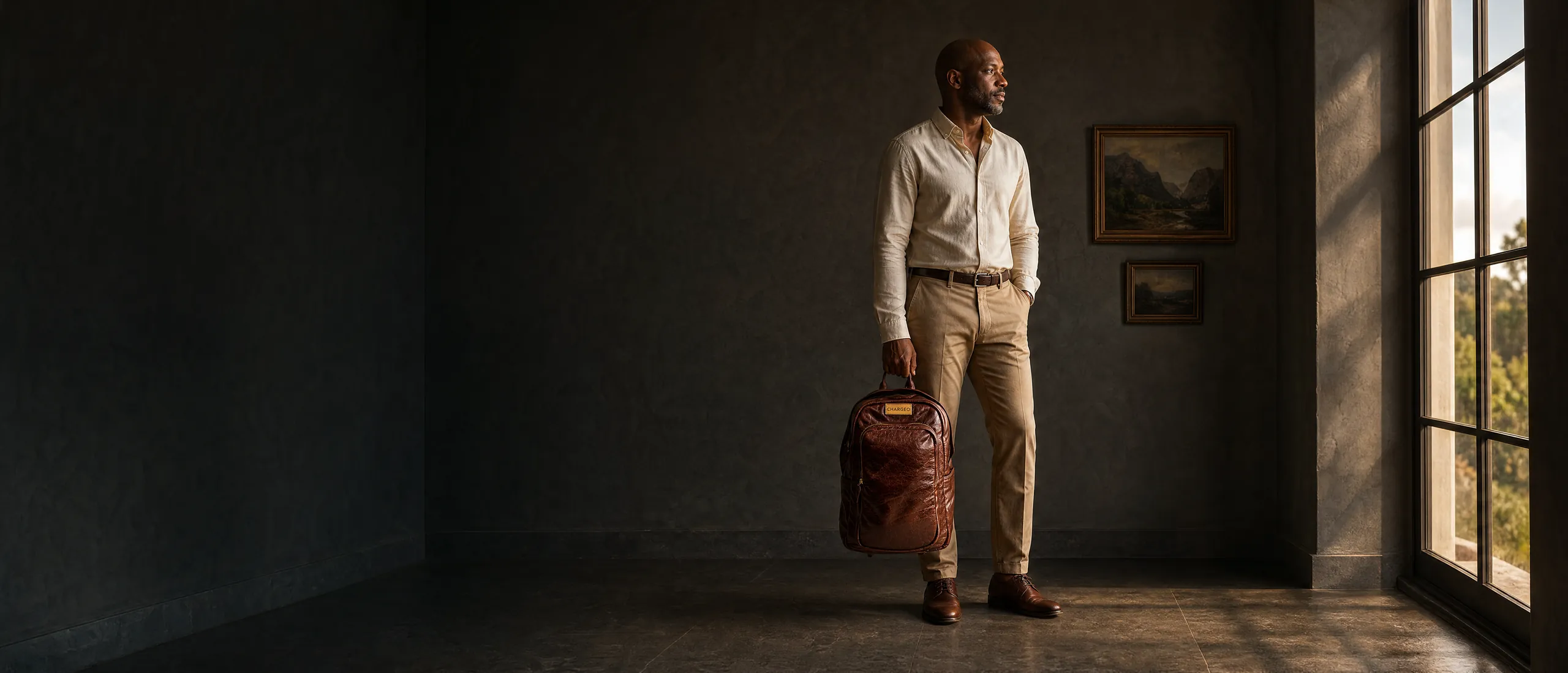
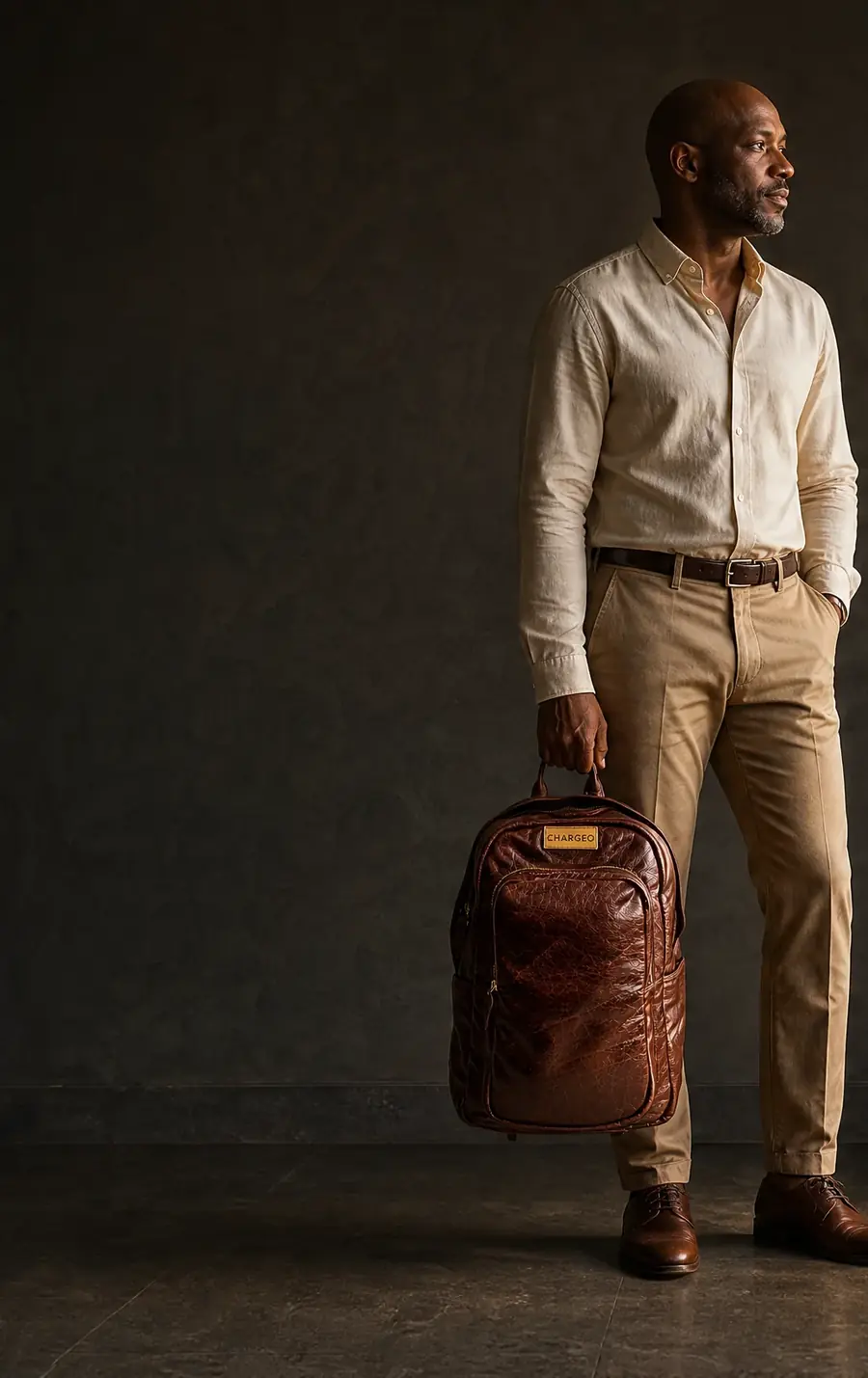
Full grain leather is the top layer of the hide with its natural grain left whole. Nothing is sanded away, so the surface keeps its pores and its marks. It is the grade we cut our leather backpacks from, apart from the Zulu Treasure Leather Backpack in Nguni hide. Below: how full-grain differs from top-grain and genuine leather, its drawbacks, and how to check a bag before you buy.
What Is Full-Grain Leather?
Full-grain leather is the outermost layer of a hide, used with its grain surface intact. The grain is the tight layer just under the hair. A tannery removes the hair and tans the hide, but does not sand or buff the surface.
That is why two full-grain hides rarely look the same. Each one carries the pores, creases and small scars of the animal it came from.
Where Does the Grain Layer Sit in a Hide?
The grain layer sits at the top of the hide, on the side that carried the hair, with a looser layer called the corium beneath it. The grain has finer, more densely packed fibres, and the corium is the more fibrous layer under it.
A tannery may split a cattle hide into layers. The top, grain layer is used to make full-grain or nubuck leather, and the bottom layer to make split or suede leather. Splitting also lets the tannery set the thickness for the product. It is done once the hide is clean or, failing that, usually after tanning. The lower layer is called the drop split, and in thicker hides it can be split again into a middle split and a flesh split.
Small skins are treated differently. Skins, which come from smaller animals such as sheep and goats, are typically less than 1 mm thick and are not split.
A leather is full-grain, then, when the top layer is kept at the splitting machine and its surface is left alone afterwards.
What Is Bovine Leather?
Bovine leather is leather made from the hide of cattle. It is the leather most bags are cut from, because a cattle hide is large and thick enough to yield whole panels. Full-grain bovine leather is the top layer of that hide.
Is Full-Grain Leather Real Leather?
Yes. Full-grain leather is real leather, and it is the least altered form of it. The hide is tanned and finished, and its surface is not replaced with a printed or embossed pattern. Our guide to the types of leather sets out the other animals and finishes.

Full-Grain, Top-Grain or Genuine Leather: Which Is Better?
Full-grain is the better choice for a bag you intend to keep, because the whole grain is still there. Top-grain, also called corrected grain, has had its surface sanded to remove marks. Genuine leather is a label that means the product is real leather, but it does not tell you which layer of the hide was used.
| Term | What it means | What you see |
|---|---|---|
| Full-grain | The top layer of the hide, grain left whole | Natural pores and marks, no two hides alike |
| Top-grain (corrected grain) | The top layer, sanded or buffed, then finished | An even surface with fewer marks |
| Genuine leather | A label for real leather of any layer | Varies. Ask which layer it is |
| Split leather | The lower layer, left after the top is split away | Often given a coated or embossed surface |
| Bonded leather | Leather fibres pressed together with a binder | A uniform, printed surface |
My advice is to ask any seller one question: which layer of the hide is this? A seller who knows the answer will tell you at once.
How Does Full-Grain Compare With Every Other Grade?
Full-grain is the only grade that keeps the whole grain layer with nothing taken off its surface. Every other grade has either altered that surface or does not have the layer at all.
| Grade | Grain layer | What is done to it | How I would expect it to age |
|---|---|---|---|
| Full-grain | The entire grain layer | No part of the surface is removed | It develops a patina |
| Top-grain (corrected grain) | Kept, with the top sanded | Flaws are buffed or sanded away, then the surface is dyed and embossed | Evenly, with little change of colour |
| Nubuck | Kept, with the top sanded | Sanded or buffed on the grain side to a slight nap | It darkens and marks where it is handled |
| Split | None | Made from the corium left once the top has been separated | As suede, the nap flattens where it rubs |
| Bicast | None | A split coated with polyurethane or vinyl, with an embossed texture | The coating wears before the leather does |
| Bonded | None | Leather scraps shredded and bonded onto a fibre mesh | I would not expect it to recondition |
The ageing column is what I expect and has not been tested. Genuine leather is absent because it is a label and can sit on any row. Suede, nappa, patent and the other finishes are set out in our guide to the types of leather.
Which Finishes Are Used on Full-Grain Leather?
Full-grain leather is typically finished with a soluble aniline dye, which leaves the grain in view. An aniline leather has a minimal surface finish, with the original grain clearly visible. Semi-aniline adds a light finish, usually with pigments, and soils less easily while the grain can still be seen. Under a pigmented finish the natural grain cannot be seen, so on a full-grain hide it covers the surface you paid for. Oils and waxes are among the other finishes a tannery can add, and our guide to the types of leather defines each of them.
Full grain leather drew between 210 and 480 searches a month in South Africa, highest in January 2026.
Searches for Full Grain Leather
Searches a month, September 2025 to August 2026
- Searches for “full grain leather”
Vegetable-Tanned or Chrome-Tanned Full-Grain: Which Should You Choose?
Choose vegetable-tanned full-grain for a firm piece that will darken with use, and chrome-tanned full-grain for a supple piece that will meet rain. Tanning and grade are separate questions, and a hide tanned by either method can be full-grain.
Leather Naturally says that vegetable-tanned leather has a distinctive look and handle, and ages beautifully, and that the use decides which method is best. For a belt I would choose vegetable-tanned. For a bag carried every day through a wet season, chrome-tanned or an oiled leather is the safer choice.
What Are the Disadvantages of Full-Grain Leather?
Full-grain leather has four main drawbacks. It costs more, it weighs more, it shows natural marks, and it needs some care.
- Price. Only hides with a clean enough surface can be used whole, so fewer hides qualify.
- Weight. It is denser and heavier than a split or bonded leather. Our leather backpacks weigh about 2.5 kg empty.
- Marks. Small scars and creases stay visible. We regard them as proof that the grain is whole.
- Care. Wipe it, condition it and store it properly. Our guide on how to clean a leather bag gives the steps.
Why Is Full-Grain Leather Expensive?
Full-grain leather is expensive because the tannery cannot hide a flaw. A hide with too many scars is sanded and sold as corrected grain. The supply is smaller, so the price is higher.
The hide is one part of the price. Our article on what makes a backpack luxury sets out the rest.
Does Full-Grain Leather Change With Age?
Yes. Full-grain leather develops a patina, which is a gradual deepening of colour and sheen where the leather is handled. The trade body Leather Naturally says that leather develops character with age and use.
A coated or printed surface cannot do this, because the grain is covered. On a full-grain bag the handle and the corners darken first.

How Does Full-Grain Leather Age by Colour and Finish?
Full-grain leather changes sooner and more visibly the paler its colour and the lighter its finish. The patina on a leather piece is unique to the type of leather, the frequency of use and the exposure, so the list below is what I would expect and not a promise.
- Natural and tan. The palest leathers show change soonest, and darken where hands and sunlight reach them.
- Brown. It deepens and gains sheen at the handles, corners and edges.
- Black. The colour changes least. Expect a change of sheen instead.
- Aniline. It is less well protected from soiling than semi-aniline or pigmented leather, so it takes up oils and marks most readily.
- Semi-aniline and pigmented. The coating slows every change. A pigmented surface alters very little, which is its purpose.
- Oiled. Light scuffs can often be rubbed back with a fingertip.
If you want a bag that looks much the same in five years, choose a dark colour and a protective finish. If you want the change, choose tan with an aniline finish, and accept the first marks.
Is Full-Grain Leather Waterproof?
No. Full-grain leather resists a light shower but is not waterproof. A soaking can leave a mark. Our article on whether leather backpacks are waterproof explains what to do in rain.
Can Scratches and Water Marks Be Removed From Full-Grain Leather?
Light scratches and many water marks can be eased at home, while deep cuts, ink and cracks cannot be fully undone.
For a light scratch, rub gently with a clean fingertip, then work in a little conditioner and buff. For a water mark, wipe the whole panel evenly with a barely damp cloth and let it dry in the air. I would stop there. In my view glue, shoe polish and colour pens each make a later repair harder. The cleaning steps are in our leather care guide, and our leather repair page sets out what a workshop can restore and what it cannot.
What Is the Lifespan of Full-Grain Leather?
Full-grain leather can serve for decades, though no single figure holds for every piece. The Wikipedia article on leather says that leather goods stay in use for decades, and that full-grain, rather than wearing out, develops a patina during its useful lifetime.
Care decides where in that range a piece falls. In my view soaking followed by heat, storage in damp or in plastic, an overfilled bag and years without conditioner all shorten it. The hide is seldom what ends the life of a bag, as I see it. A seam, a zip or a strap gives way first, and each of those can be repaired.
What Is Full-Grain Leather Used For?
Full-grain leather is used where the surface will be seen and handled for years: footwear, furniture, bags, belts and luggage. Furniture and footwear are often made from full-grain leather.
The same grade is not the same leather in every product, because splitting allows the thickness to be adjusted for the final product. Leather Naturally gives walking boots as its example, which need a thicker, firmer leather.
In a belt, full-grain is a single strap, and the pull falls on the buckle holes. Look at the cut edge. It should show one dense layer, with no filler between two thin skins. I would choose a firm leather for it, and vegetable-tanned hide is used for belts.
A bag is cut in panels, and there suppleness matters more than firmness. Look for whole panels with few seams across the face, and expect weight.
Can Full-Grain Leather Be Tumbled, Pebbled or Embossed?
Yes. Tumbling and embossing are done to the surface after tanning, and neither one takes the grain layer away.
Tumbled leather has been softened in a dry tumble drum, which also enhances the natural grain structure. The pattern you see is that of the hide. Embossed leather has a print or surface pattern created by pressure, so the pattern is that of the plate. Pebbled describes a look, a surface of small rounded bumps, and it is worth asking the seller whether it came from the drum or from a plate.
An embossed full-grain leather still has its grain layer, but its natural surface can no longer be read, and the checks in the next section will not work on it. Corrected grain goes a step further: its flaws are buffed or sanded away before it is embossed.

How Do You Know a Bag Is Full-Grain Leather?
You can tell full-grain leather by looking closely at the surface, the edges and the label.
- Look for pores and small irregular marks. A surface that repeats the same pattern has been embossed.
- Look at a cut edge. Full-grain shows one dense layer of fibres, with no fabric backing.
- Read the label and the product page. It should use the words full-grain.
- Press the surface with a finger. The grain wrinkles finely and recovers.
How Do You Check a Product Description and a Seller?
Read the materials line for the words full-grain, and treat every other leather word as a question to put to the seller.
| The description says | What it tells you | What I would ask |
|---|---|---|
| Full-grain leather | The layer, and that the surface is unsanded | Which animal, and how the hide was tanned and finished |
| Top-grain leather | The top layer, with its surface sanded or buffed and then finished | How heavily the surface was corrected, and what finish covers it |
| Genuine leather or real leather | That the product is real leather and not a synthetic alternative | Which layer of the hide it is |
| Made with leather, or leather trim | I read it to mean that only part of the piece is leather | Which parts are leather, and what the rest is |
| Bonded leather | Leather dust, clippings and shavings bonded together with a base substance, usually synthetic | What share of the material is leather fibre |
| A country, such as Italian leather | I read it as where the hide was tanned or the piece was made. It names no grade | Which layer of the hide it is |
Then judge the seller. I would want a named maker, close photographs of the piece itself, a written guarantee, a stated return period and an answer about repairs. Once a piece costs more than R1,500, get the words full-grain in writing as well, and keep the answers with your receipt.
What Are the Common Myths About Full-Grain Leather?
Four claims about full-grain leather are worth correcting: that it is always thick, that it never marks, that genuine leather is fake, and that full-grain is untreated.
- Full-grain is always thick. The term names the layer and says nothing of thickness. Hides are split, which allows the thickness to be adjusted for the final product, so a full-grain leather may be thin or heavy. Ask for the thickness in millimetres.
- Full-grain never marks. Light scratches show on it, because nothing covers the grain. I would expect a coated leather to hide them better and to change less with age.
- Genuine leather is fake. It is real leather. The trouble with the term is that it does not describe a specific grade, so a piece marked genuine may be full-grain or a coated split.
- Full-grain is untreated. It is tanned, dyed and finished as any leather is. What it is spared is sanding.
Which Leather Do We Use?
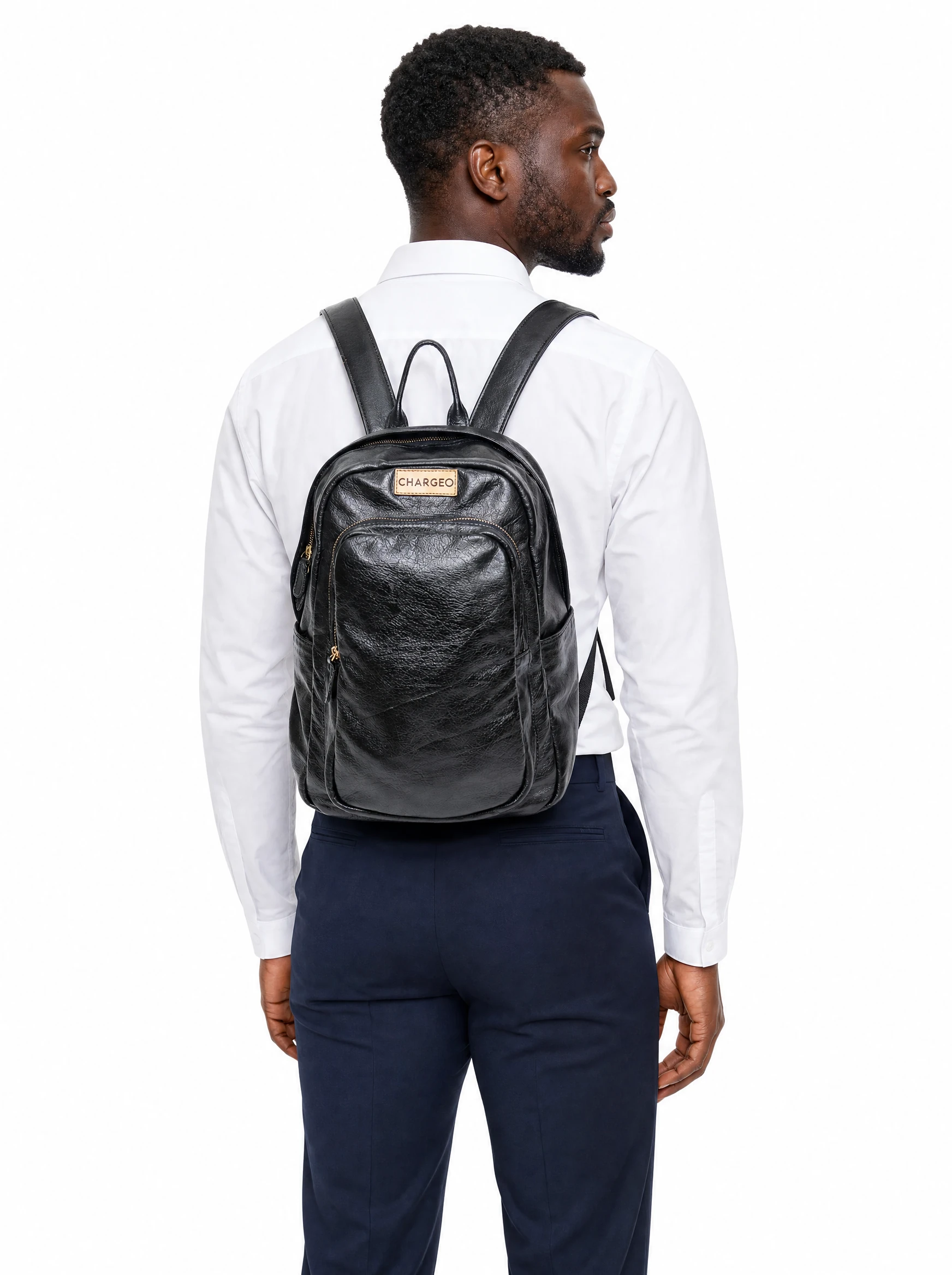
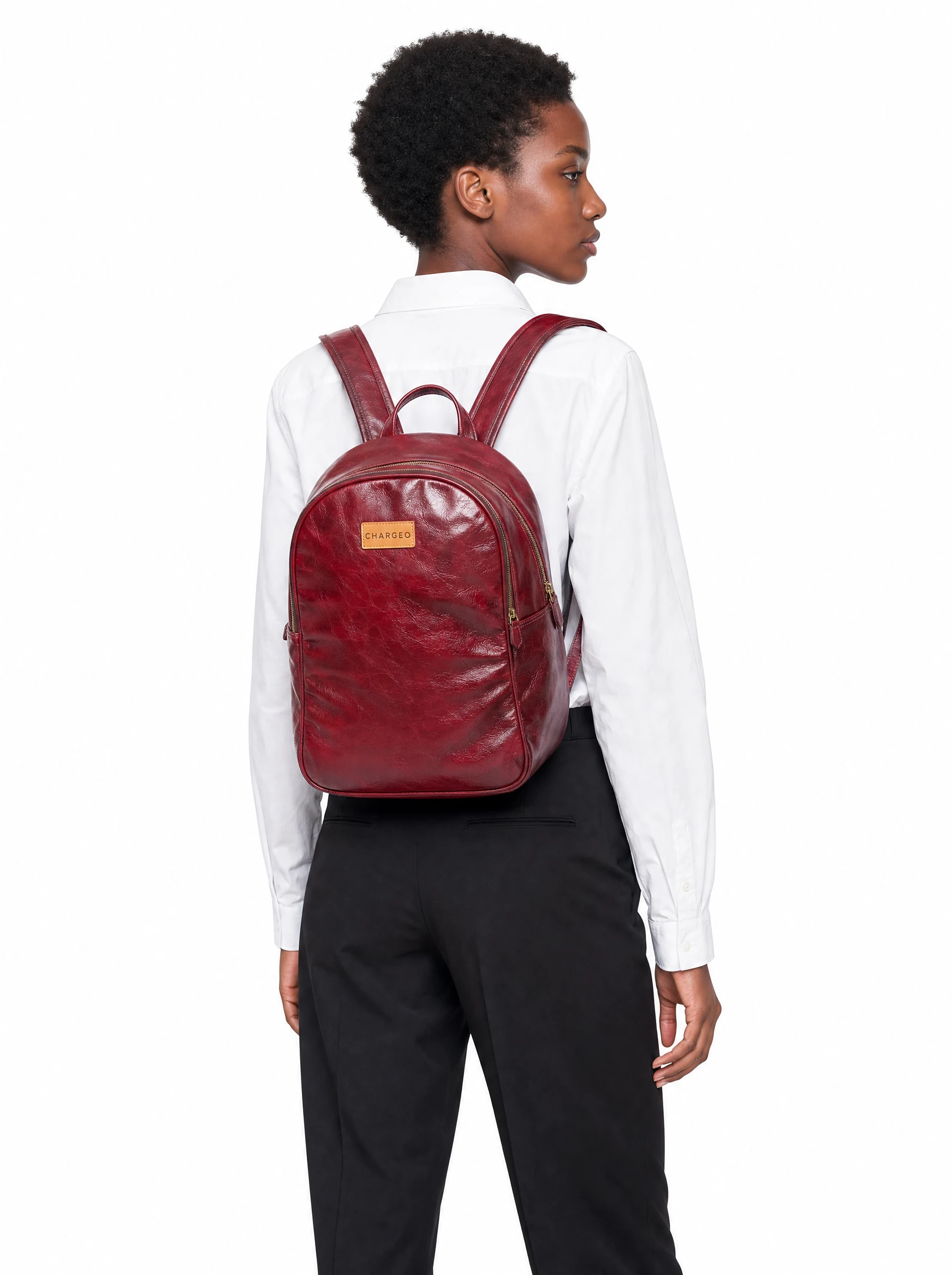
We cut our leather backpacks from full-grain bovine leather, oil coated and sourced in South Africa. Each one is lined in poly-cotton and made to order here, usually in 30 days. When our order book is full it can take up to three months.
Our product pages say genuine leather, because it is real leather and not a substitute. It is also full-grain, which the word genuine does not tell you.
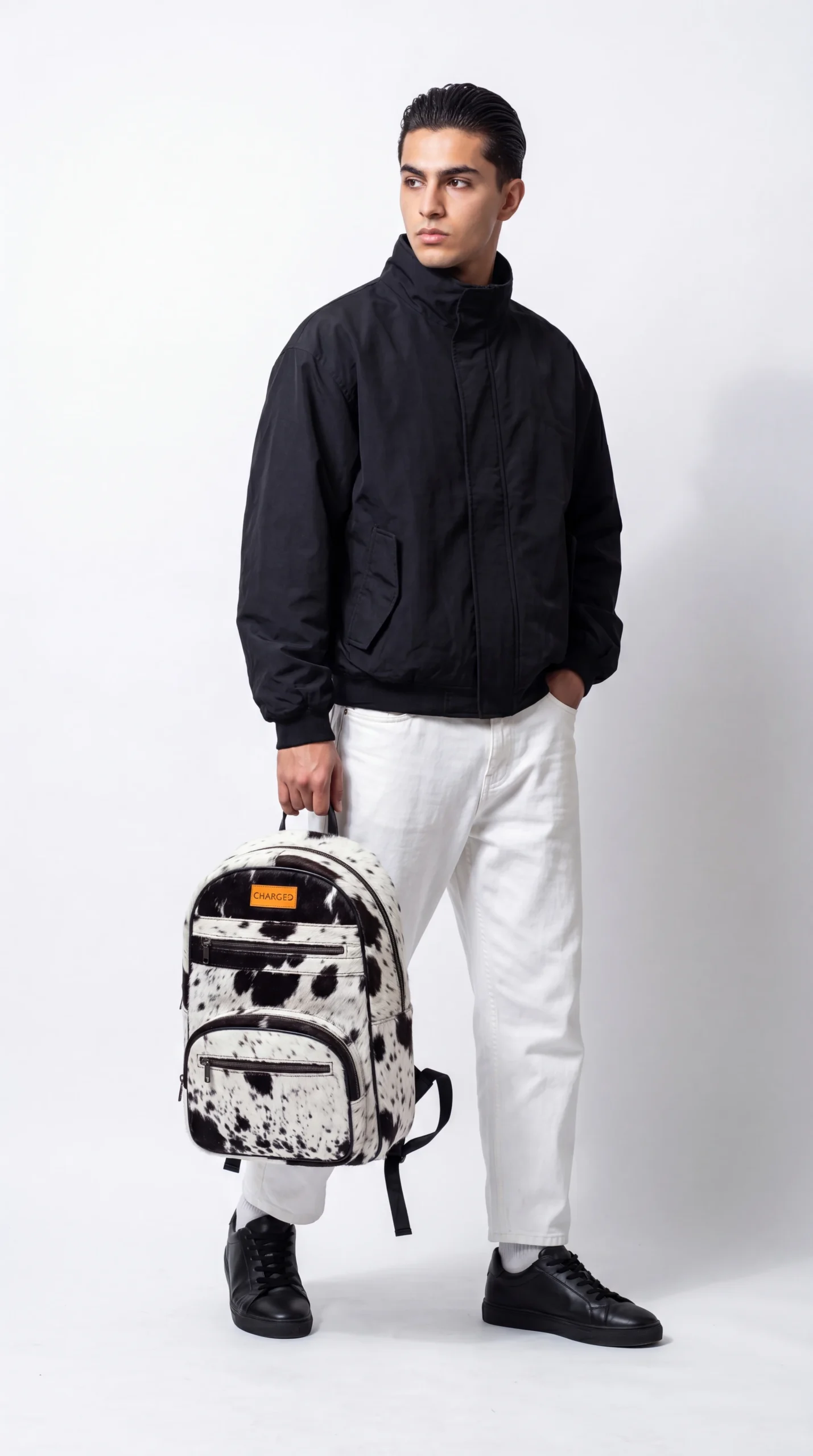
The Zulu Treasure Leather Backpack is cut instead from Nguni hair-on-hide, so each piece carries its own markings. Read more about our sustainably sourced leather, or see all our leather backpacks. For size, fit and price, read our leather backpack buying guide.
More on Leather Backpacks
Questions, Answered
What is full-grain leather?
Full-grain leather is the top layer of the hide with its natural grain left whole. The surface is not sanded or embossed.
What is bovine leather?
Leather made from the hide of cattle. Full-grain bovine leather is the top layer of that hide.
What is better, full-grain or top-grain leather?
Full-grain is the better choice for a bag you intend to keep, because the whole grain is still there. Top-grain, also called corrected grain, has been sanded for an even surface.
Is genuine leather the same as full-grain leather?
No. Genuine leather is a label that means the product is real leather. It does not say which layer of the hide was used.
Does full-grain leather scratch?
Yes. Light scratches show on full-grain leather. Many ease when rubbed with a clean fingertip and a little conditioner.
What is the lifespan of full-grain leather?
It can serve for decades, though no single figure holds for every piece. Care decides it: avoid soaking and heat, store it dry, and condition it. In our view a seam, a zip or a strap usually gives way before the hide, and each can be repaired.
What are the disadvantages of full grain leather?
It costs more, it weighs more, it shows natural marks and light scratches, and it needs some care. Light scratches and many water marks can be eased at home. Deep cuts, ink and cracks cannot be fully undone.
Is full-grain leather always thick?
No. Full-grain names the layer of the hide and says nothing of thickness. Hides are split so that thickness can be set for the product, so ask for it in millimetres.
Read all our questions and answers