


Race day outfits in South Africa are smart daytime clothes chosen for the season and the city: a suit or a jacket and trousers for men, a day dress or a trouser suit for women, a hat, and shoes that cope with grass. Below are the main race days with their dates and dress codes. Then come what men wear in a Cape Town summer, a Durban winter and a Johannesburg late spring, what women wear, what to leave at home, and a timeline that ends with a checklist. We sell almost none of it. We make leather belts and one loafer, and the last section says where they fit.
What Does Race Day Dress Mean?
Race day dress means smart clothes for a daytime occasion outdoors, finished with a hat. It is a daytime standard. I would leave the dinner suit, the gown and thin heels for a night indoors and dress for sun, wind and turf.
The clearest statement of the standard we found in South Africa is the guidance one event gives its fashion judges. The look, it says, is what would be worn at a raceday, not at an evening event, and the hat, accessories, shoes and grooming all count.
Abroad, some race meetings call for morning dress, a code its encyclopaedia entry ties to festive functions such as summer weddings and horse races. No South African race day we read asks for it. Here I would wear a lounge suit or smart separates by day. Formal traditional attire meets the standard too, in my view.
If your invitation uses an evening phrase instead, our guide to cocktail attire for men explains what each one asks for.
Which Are the Main South African Race Days, Their Dates and Dress Codes?
The five race days below fall in three seasons: summer in Cape Town, midwinter in Durban and late spring in Johannesburg, and only one of them states a dress code as a rule. Each row links the event's own site, and the dates are those shown there on 13 October 2026.
| Race day | Date | City | Dress |
|---|---|---|---|
| Summer Cup | Saturday 28 November 2026 | Johannesburg, Turffontein | The site says dress to impress. Theme for 2026: Celebrate Summer |
| Cape Guineas | 16 December 2026 | Cape Town, Kenilworth | No dress code on the page we read |
| King's Plate | Saturday 9 January 2027 | Cape Town, Kenilworth | Blue and white |
| Cape Town Met | Saturday 30 January 2027 | Cape Town, Kenilworth | No theme yet. The page says more information is coming |
| Durban July | 3 July 2027 | Durban, Greyville | A theme each year, announced in February or March in past years |
Dates move, so confirm on the event's site before you book travel, and read its dress page in the month before you dress.
- The King's Plate. Its general information page gives the dress code as blue and white and requires guests to dress in a manner appropriate to racing. Best dressed and best hat are judged on the day.
- The Durban July. Its site says the build-up starts when the theme is announced and peaks on the first Saturday of July. In past years the theme came in February or March. Our list of Durban July themes by year gives the past themes and how to dress for one.
- The Summer Cup. It is held at the end of November. Its guide for 2026 sets the theme Celebrate Summer and describes the look as the meeting of classic racewear and Jozi cool.
A colour code is a rule: follow it. A theme is a prompt: I would put it into one or two pieces, such as a tie, a pocket square, a hat band or a print, and keep the rest of the outfit correct without it.
The same courses list ordinary meetings between these days. We found no dress standard published for those, so this guide keeps to the feature days.
What Do Men Wear, by Season and City?
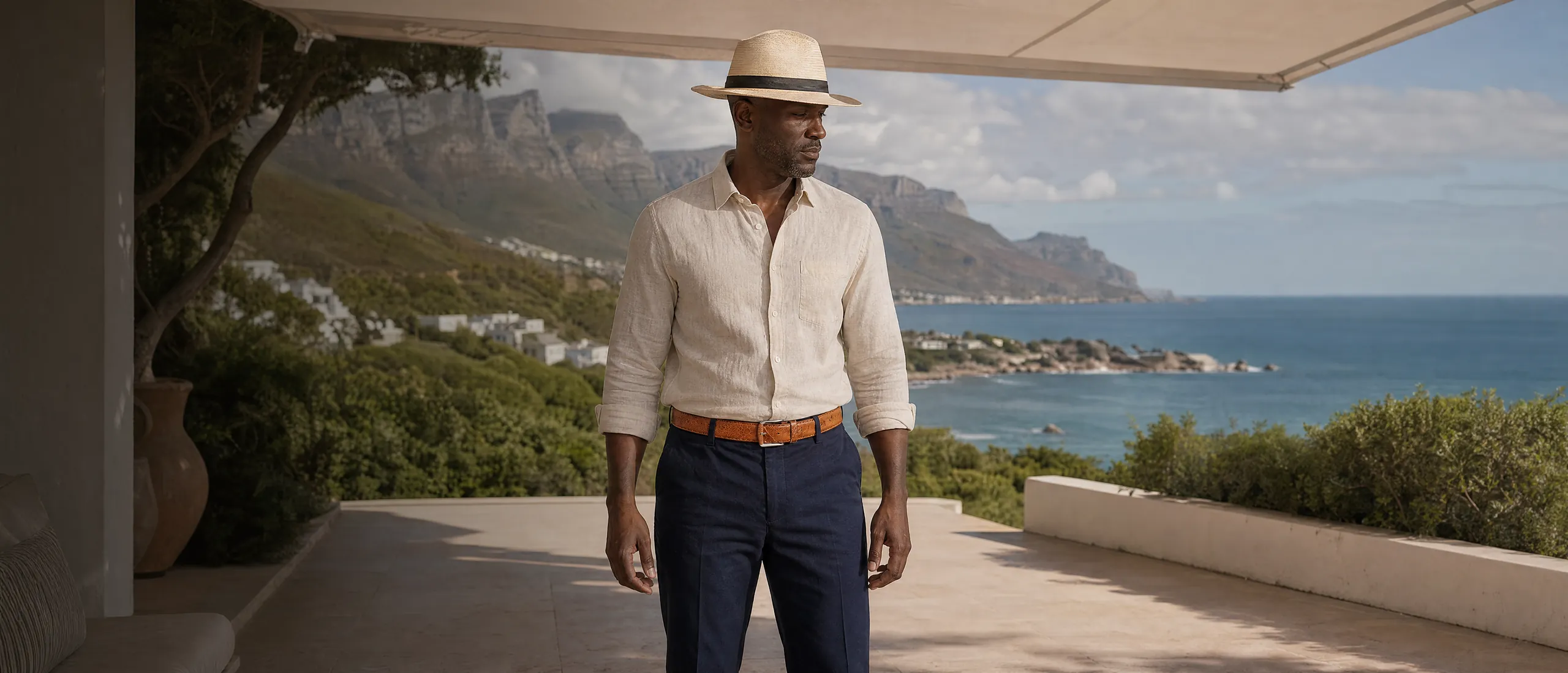
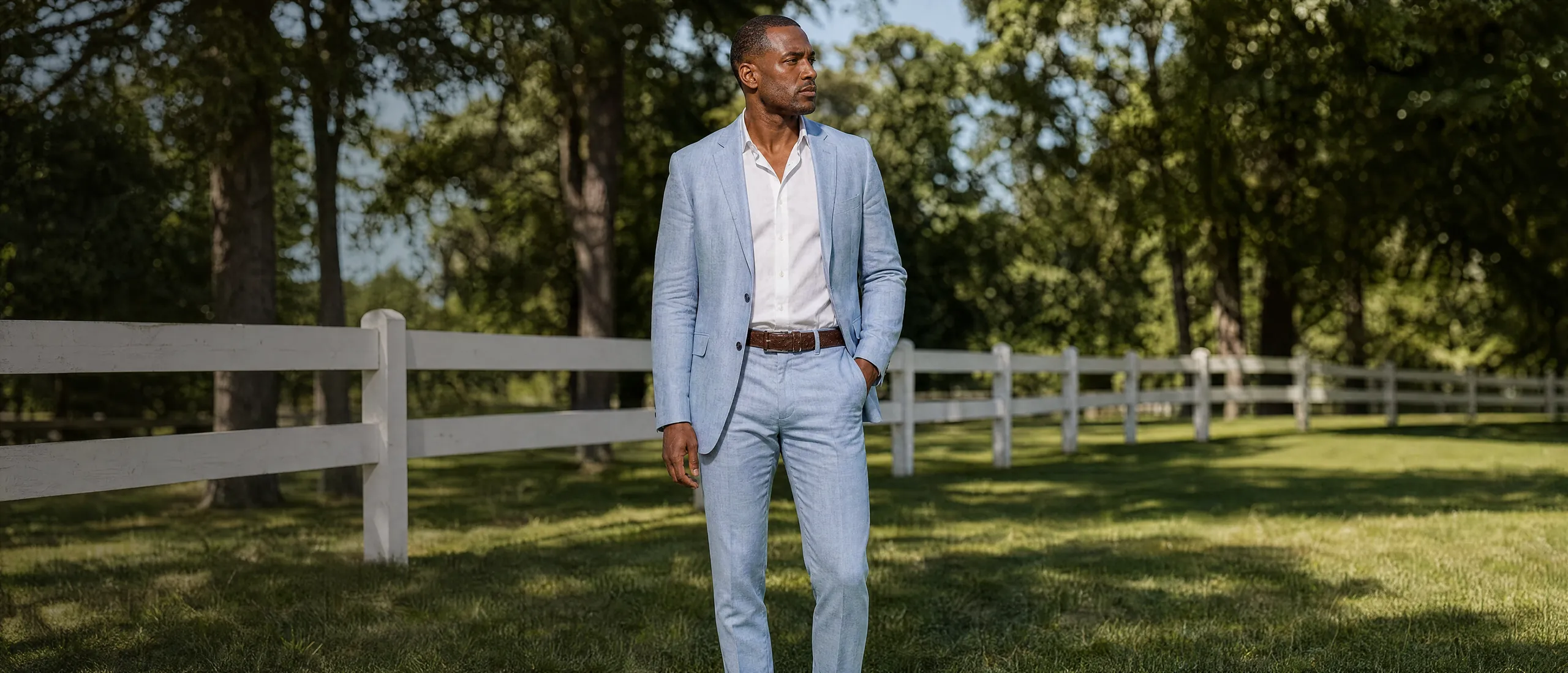
Men wear a suit or a jacket with smart trousers to a South African race day, and my advice is to let the season decide the cloth and the colour.
| Setting | Weather | Suit | Cloth | Colour |
|---|---|---|---|---|
| Cape Town, January | Hot and dry, often windy | Two pieces, or a jacket and trousers | Linen blend, seersucker or light wool | Stone, pale blue, light grey. Blue and white where the code asks |
| Durban, July | Mild by day, cool after dark | Two or three pieces | Light or mid-weight wool | Mid-blue, grey, navy, earth tones |
| Johannesburg, November | Warm, with afternoon storms | Two pieces, or separates | Light wool with a smooth finish | Navy, mid-blue, tan, one bright detail |
Cape Town International Airport records a mean daily maximum of 27.0 degrees Celsius in January. Durban in July averages a daily high of 22.8 degrees and a low of 10.8. Johannesburg has a November high of 25.1 degrees and regular daily thunderstorms in the afternoons between November and March. Those figures explain the weather column, and the suits, cloths and colours beside it are my advice.
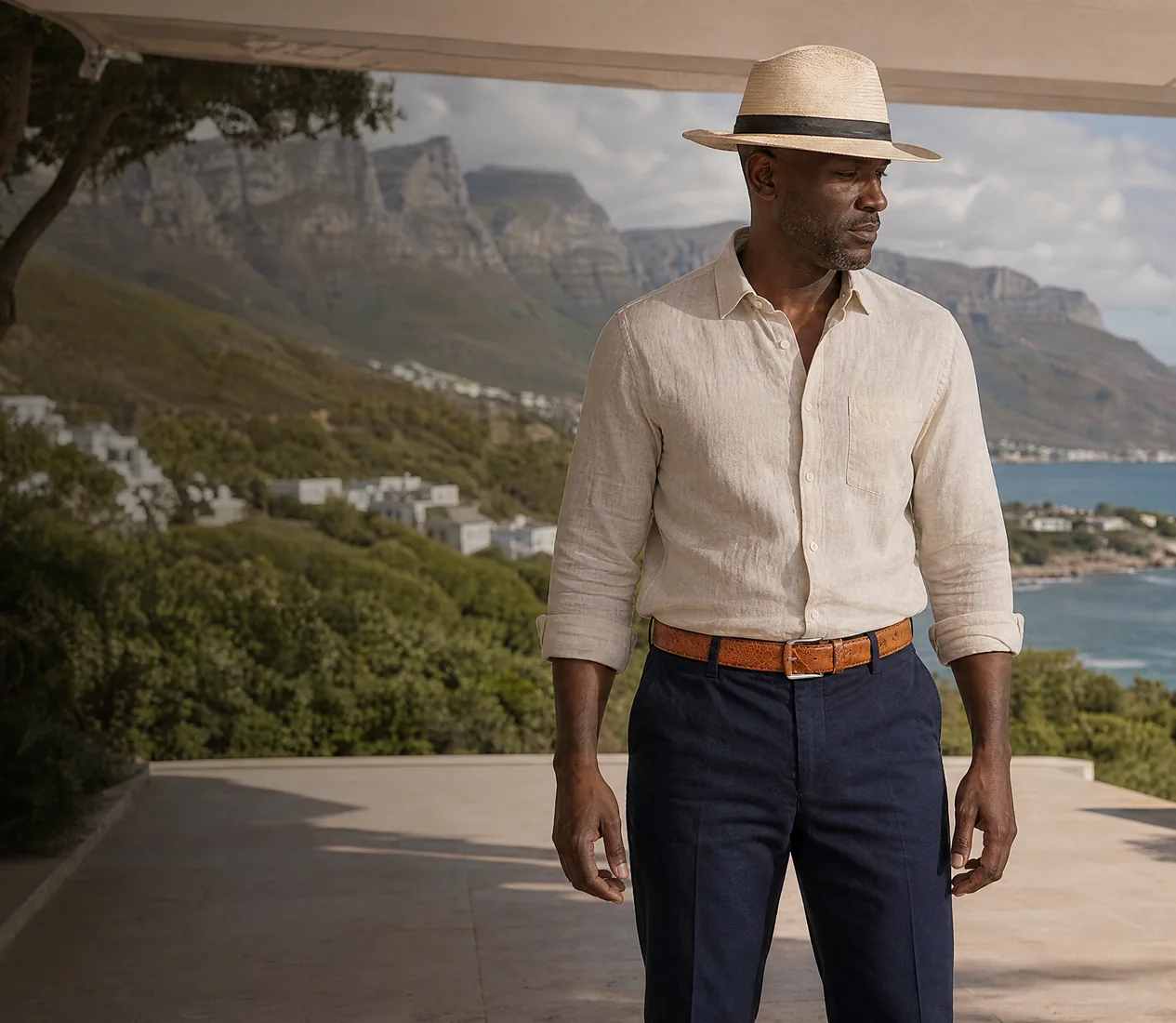
- Cape Town in summer. Heat is the problem. Linen clothing is comfortable to wear in hot weather and wrinkles, so I would choose a blend. Seersucker is woven so that the cloth is mostly held away from the skin. Ask for a half-lined or unlined jacket. A hat needs to fit closely, because spring and summer there generally bring a wind from the south-east, known locally as the south-easter.
- Durban in winter. The day starts mild and ends cool, so wear a jacket you can take off and put back on. A waistcoat keeps the outfit complete in between. Our guide to what to wear to the Durban July covers that day in full.
- Johannesburg in late spring. Plan for an afternoon storm. I would leave suede and pale linen at home, wear a smooth wool and carry a compact umbrella.
Suit or separates is a question of where you will stand. None of the five sites sets a different code for its hosted and general areas, so this part is my advice. In a hosted room, deck or marquee I would wear a suit and tie, because the floor is hard and there is a seat. In a general area a jacket with trousers in a different cloth is correct and cooler, and you will stand on grass for most of the day, so choose the shoes first. As a guest, ask your host: a company that takes a table may set a standard of its own.

Which Shirt, Tie, Hat, Shoes, Socks and Belt Finish the Outfit?
A collared shirt, shoes with grip, a belt in the colour of the shoes and a hat finish the outfit, and the tie depends on where you are seated. These are the choices I would make.
| Piece | Choose | Why |
|---|---|---|
| Shirt | White or pale cotton or linen, tucked in | It stays neat when the jacket comes off |
| Tie | On in a hosted area, optional on the lawn | An open collar on a pressed shirt is correct by day |
| Hat | A straw Panama in summer, felt in winter. Off indoors and at the table | Shade for a full day in the sun |
| Shoes | Lace-ups with a slim rubber sole and a low, broad heel | Grip on damp turf, and a heel that stays on top of it |
| Socks | The colour of the trousers, fine cotton or wool | Bare ankles are for a relaxed outfit on paving |
| Belt | Leather, in the colour of the shoes | It is on show from the moment the jacket comes off |
On shoes, turf decides. I would not trust a smooth leather sole on damp grass or a narrow heel on soft ground. If your best shoes have leather soles, ask a cobbler to add a thin rubber layer, and wear the pair at home for two weeks before the day. Our guide to loafers for men explains which slip-on shoes are formal enough for a suit.
On the belt, match the leather to the shoes and keep the buckle small with a suit. Trousers made with side adjusters take no belt. Wear a belt or braces, never both.

What Do Women Wear to the Races?
Women wear a day dress, a skirt and top, a jumpsuit or a trouser suit, with a hat or a fascinator and shoes that stay on top of the grass. We sell no dresses, hats or heels, so what follows is advice and nothing else.
- Keep it daytime. A dress you could wear to a summer wedding at noon is nearer the standard than an evening gown.
- Dress for the season. Light cloth and sleeves or a wrap against the sun in Cape Town. A layer for the evening in Durban. A cloth you would not mind wearing through a shower in Johannesburg.
- Wear a headpiece. A fascinator is a formal headpiece worn as an alternative to a hat, fixed to a band or clip. In wind, my choice is the clip over a wide brim.
- Choose a block heel or a wedge. I would not trust a thin heel on turf. Carry flat shoes for the walk to the car.
- Read the code. Where an event names colours, they apply to women as much as to men.
Black is allowed where no colour code is set. I know of no South African race day that forbids a black dress, but it does not meet a blue and white code, so check the code first and lighten black with a hat and colour.
What Should You Not Wear to a Race Day?
Do not wear evening wear, weekend clothes, thin heels on grass or anything that breaks a stated colour code. The last is a rule where it is published. The rest is my advice.
- A dinner suit or a ball gown. Both belong to the evening, which the judging guidance quoted earlier sets apart from what is worn at a race day.
- Jeans, shorts, sandals, trainers and caps. I place them below the standard of a feature day.
- Suede and pale linen under a storm forecast. Neither is a cloth to risk in rain.
- A costume. An outfit that is all theme and no fit reads as fancy dress.
- A belt in one colour and shoes in another. It shows as soon as the jacket comes off.
- New shoes. You will be on your feet for most of the day, so wear a pair you have already worn.
When Should You Start Planning a Race Day Outfit?
Start eight weeks before the day if you are buying ready-made clothes, and three months before if anything is being made for you. Count back from the race day, and run the checklist the evening before.
| When | Action |
|---|---|
| Three months before | Order anything made to order or made to measure. Ask for the delivery date in writing |
| Eight weeks before | Read the code or the theme on the event site. Choose the suit or dress and the shoes |
| Six weeks before | Buy ready-made clothes and book alterations |
| Four weeks before | Buy the hat. Buy tickets and parking if you have not |
| Two weeks before | Try everything on together. Start wearing the shoes at home |
| The week before | Check the forecast. Collect alterations. Press and polish |
| The evening before | Go through the checklist below |
- Outfit, pressed and hung, checked against the code or the theme.
- Shoes, polished and worn in, with the soles checked for grip, and the belt and socks laid out beside them.
- Hat or fascinator, sunglasses and sunscreen.
- For the weather: a knit for Durban, an umbrella for Johannesburg, a hat that holds in Cape Town.
- Tickets, for entry, for parking and for any hosted area, on paper or on a charged phone.
- The journey: the gate, the arrival time, and where and when you will be collected.
Counted from the dates above, three months before the two January days in Cape Town was October 2026, so for those days rely only on a delivery date the maker confirms. Three months before 3 July 2027 is 3 April. For the Johannesburg day on 28 November 2026, I would wear what I own and have it altered.

What Do We Make for a Race Day?
We make two things a man can wear to the races: leather belts and one black patent loafer. CHARGEO is a luxury fashion house, born in South Africa. We make no suits, dresses, hats or ties, and we have no connection with any race day, its organisers or its sponsors.
| Piece | Price | Fits | Avoid |
|---|---|---|---|
| Leather belts | R3,500 to R5,000 | The waist of a suit or separates, at any race day | An order placed in the month before the day |
| CHARGEO loafers | R3,500 | Paving, a deck or a hosted room, on a dry day | Damp grass and a full day on turf |
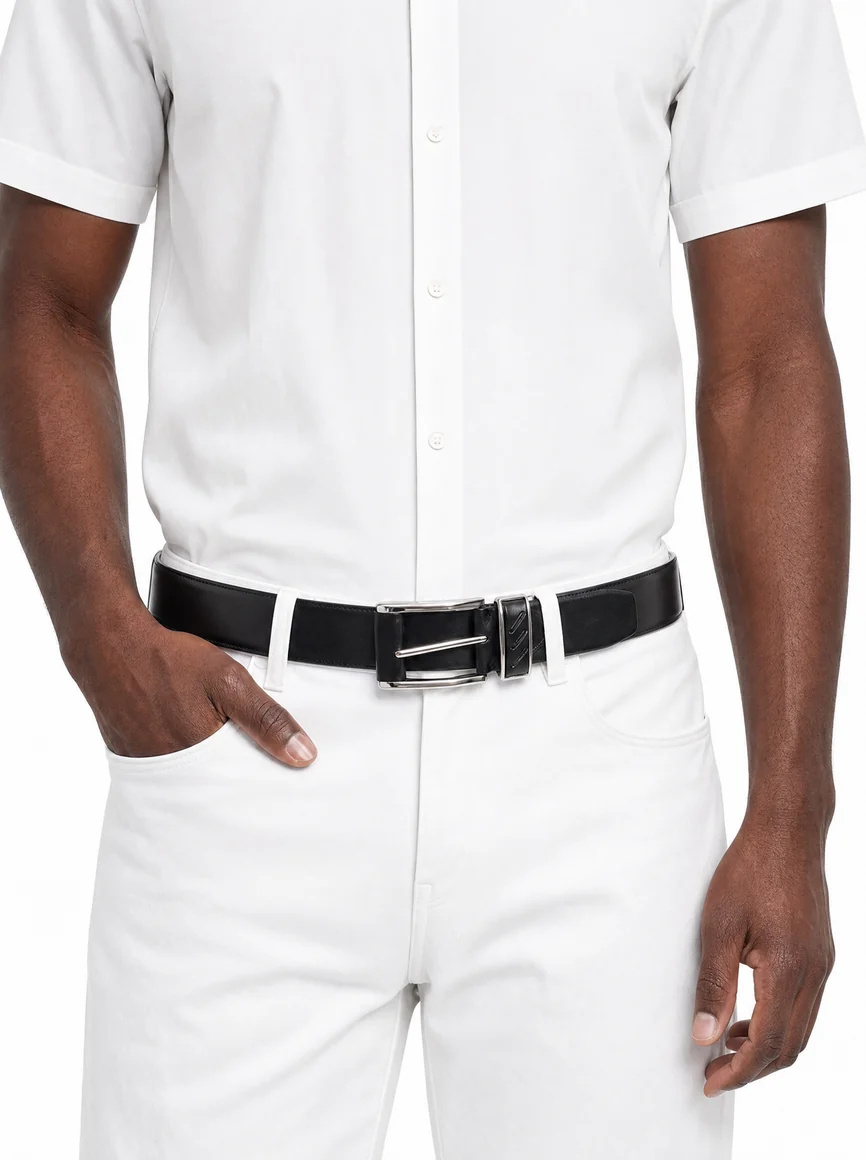
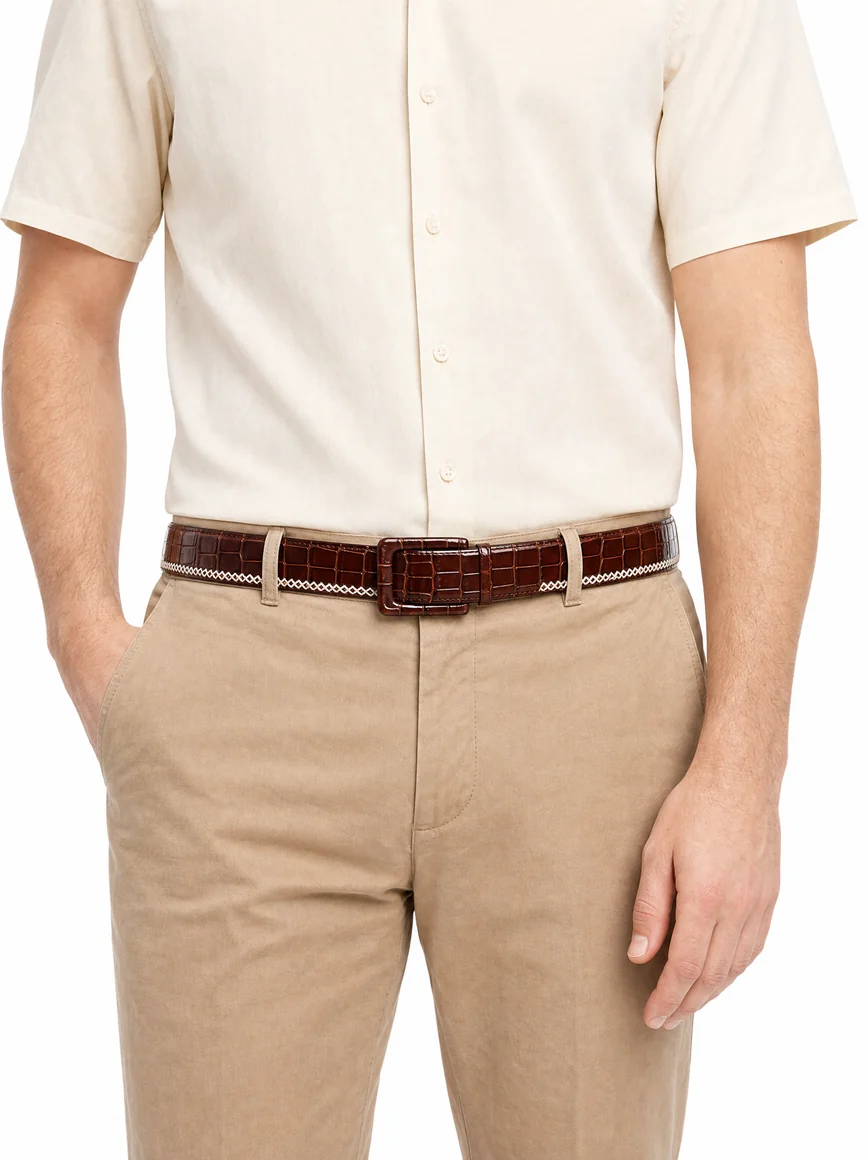
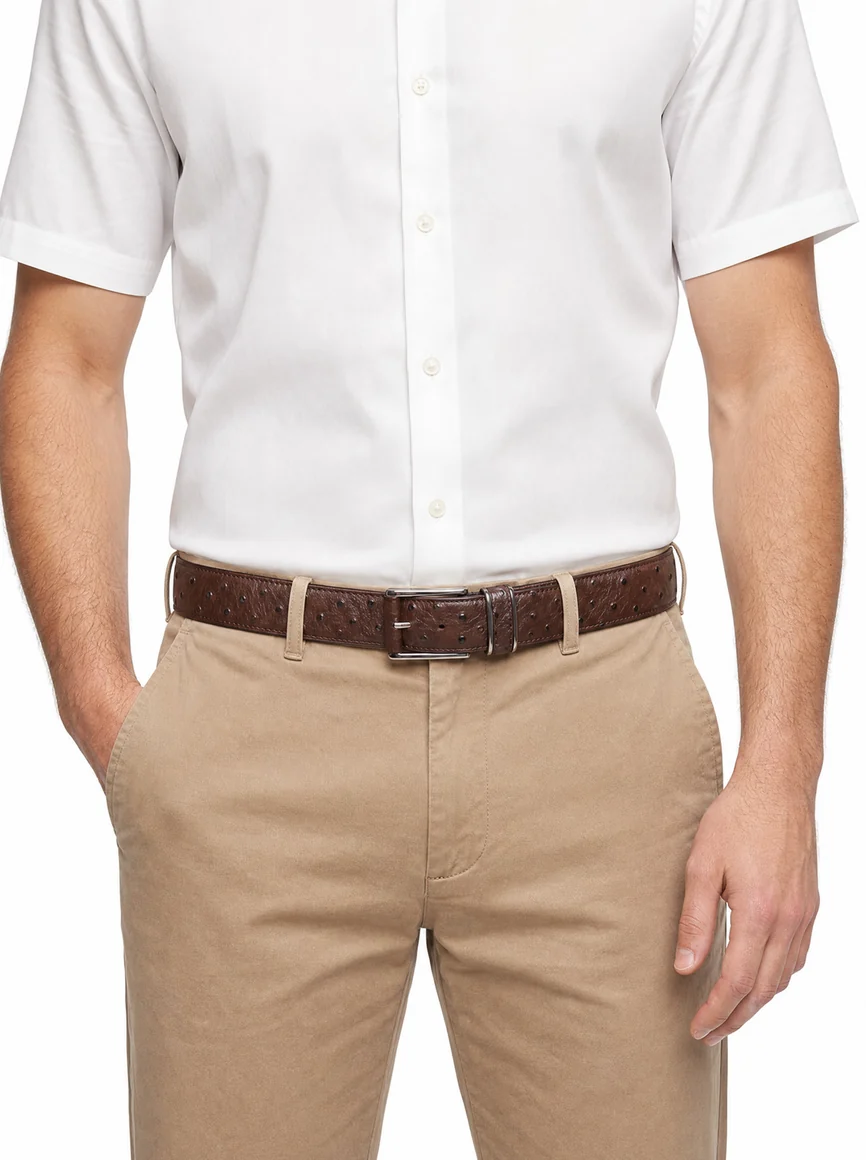
Our leather belts are made to the size you give us, in full-grain bovine leather, ostrich, crocodile or Nguni hide. The African Dawn Leather Belt is black, costs R3,900 and goes with black shoes under any code. The Safari Crocodile Belly Belt and the Kruger Ostrich Hide Belt can be the one piece that answers a theme against a plain suit. If the budget for the whole outfit is under R3,500, spend it on fit and shoes and wear a belt you own.
CHARGEO loafers come in one style: a black patent leather tassel loafer with a leather sole finished in red, in sizes UK 6 to 12, at R3,500. Some readers will know the style by the search phrase red bottom shoes for men. Patent leather is a type of coated leather with a high-gloss finish, and it is first an evening and occasion leather. Our view is that the pair also works as a relaxed race-day shoe on paving, with dark trousers, one turn-up and a linen shirt. On grass it has limits: a leather sole is smooth and has little grip on damp turf, and patent shows every scuff and grass stain. For a day spent on a lawn, wear a lace-up with a rubber sole.
A belt usually takes 30 days to make and up to three months when the order book is full. The loafers are made to order: allow up to two months. Count back from your race day. An order placed in November 2026 will not arrive for the Johannesburg day on 28 November. For the January days in Cape Town a belt ordered after early October 2026 may not arrive, so ask us for a date before you rely on it. Order the loafers by 9 November for 9 January, or by 30 November for 30 January. For 3 July 2027, order the belt by 3 April and the loafers by 3 May. Delivery in South Africa is free. If the size is wrong, our return policy allows an exchange or a return within 15 days.
More Guides
Questions, Answered
What do people wear at the races in South Africa?
Smart daytime clothes. Men wear a suit or a jacket with smart trousers, a collared shirt, leather shoes and often a hat. Women wear a day dress, a jumpsuit or a trouser suit with a hat or a fascinator. Evening wear is the wrong standard.
What are some casual outfits for men to wear to race days?
A navy or stone jacket with trousers in a different cloth, a pale shirt with the collar open, a leather belt and brown lace-ups or loafers. That is as casual as I would go at a feature race day. I place jeans, shorts and trainers below it.
Can you wear a black dress to the races?
Yes, where the event sets no colour code. Lighten it for daytime with a hat or a fascinator and some colour. At a race day with a blue and white code, black does not meet the code.
Which South African race day has a strict dress code?
The Cape Town race day held at Kenilworth on 9 January 2027 states its dress code on its own site as blue and white. The other feature days we read publish a theme, a general request to dress well or nothing yet.
Do men have to wear a tie at the races?
We found no South African race day that requires one. In a hosted room or marquee I would wear a tie and take it off later if the host does. On the lawn an open collar on a pressed shirt is correct.
What shoes should you wear to a race day?
Shoes with grip and a broad heel. For men I would choose a lace-up with a slim rubber sole. For women, a block heel or a wedge. I would not trust a thin heel on turf or a smooth leather sole on damp grass.
Read all our questions and answers